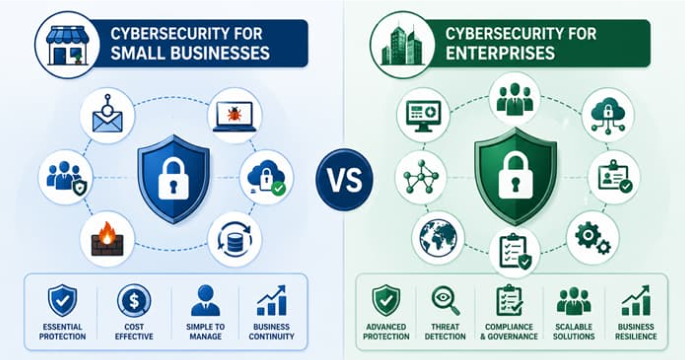
Cybersecurity is not a one-size-fits-all challenge. A small business with ten employees and a regional enterprise with thousands of users face fundamentally different threats, operate with different resources, and require different security approaches.
Yet one assumption consistently puts both at risk - the belief that cybersecurity is either too expensive for small businesses or already handled for large ones. In reality, both small businesses and enterprises face serious cyber risks. The difference lies in what those risks look like, what solutions are appropriate, and how to build a security program that matches the organization's size, complexity, and budget.
What this article covers:
- Why cybersecurity needs differ by business size
- Specific challenges facing small businesses and enterprises
- What cybersecurity services each requires
- Full comparison of SMB vs enterprise security needs
- How to choose the right approach for your organization
- Saudi Arabia-specific considerations for both
Why Cybersecurity Needs Differ by Business Size
The gap between small business and enterprise cybersecurity is not simply about budget. It reflects fundamental differences in attack surface, internal expertise, compliance obligations, and the nature of threats each organization faces.
Why Small Businesses Are Increasingly Targeted
Small businesses are frequently targeted precisely because attackers know they are less protected. Many SMBs operate with basic security controls - antivirus software, a standard firewall, and little else. They often have no dedicated IT security staff and rely on general IT support for everything from printer troubleshooting to breach response.
Attackers exploit this gap. Phishing campaigns, ransomware attacks, and credential theft are disproportionately successful against small businesses because employees are not trained to recognize threats, systems are not monitored, and recovery plans do not exist.
Why Enterprises Face More Complex Threats
Large organizations face a different category of risk. Their attack surface spans hundreds or thousands of endpoints, multiple locations, cloud environments, remote users, and an extensive ecosystem of third-party vendors and partners. Adversaries targeting enterprises are often more sophisticated - using advanced persistent threats, supply chain attacks, and social engineering against high-value targets.
Enterprises also carry heavier compliance burdens. Regulations such as PDPL KSA, the NCA Essential Cybersecurity Controls, and the SAMA Cyber Security Framework impose specific technical and governance requirements that require dedicated expertise to implement and maintain.
Cybersecurity Challenges for Small Businesses
Most Common Cyber Threats Facing Small Businesses
Small businesses consistently face the same categories of attack:
- Phishing and business email compromise: fraudulent emails targeting employees to steal credentials or authorize fraudulent payments
- Ransomware: malware that encrypts business data and demands payment for recovery
- Credential theft: attackers compromising weak or reused passwords to access business systems
- Unpatched software vulnerabilities: outdated systems that attackers actively scan for and exploit
- Insider threats: accidental or intentional misuse of data by employees
Why SMBs Cannot Afford to Ignore Cybersecurity
The cost of a cyber incident for a small business is disproportionately severe. A successful ransomware attack can halt operations entirely. A data breach can result in regulatory penalties under PDPL KSA, customer trust damage, and recovery costs that strain or exceed available resources.
Many small businesses that experience a serious cyber incident do not fully recover. Prevention is significantly less expensive than response.
Cybersecurity Challenges for Enterprise Organizations
Most Common Cyber Threats Facing Enterprises
Enterprises face a broader and more sophisticated threat landscape:
- Advanced persistent threats (APTs): targeted, long-term campaigns by sophisticated adversaries seeking to maintain persistent access
- Supply chain attacks: compromising vendors or partners to gain indirect access to the target organization
- Insider threats at scale: with hundreds or thousands of employees, the risk of accidental or intentional data exposure is significantly higher
- Cloud misconfigurations: complex multi-cloud environments create security gaps when configurations are not carefully managed
- Identity and access abuse: compromised privileged accounts can provide attackers with broad access across enterprise systems
- Regulatory non-compliance: failure to meet NCA ECC, PDPL, or SAMA requirements creates enforcement exposure alongside technical risk
Why Enterprise Cybersecurity Requires a Different Approach
Enterprise security cannot be managed reactively or with basic tools. The scale and complexity of the environment requires continuous monitoring, structured governance, dedicated security operations, and strategic leadership. A breach in an enterprise environment can affect thousands of customers, expose sensitive financial or health data, and trigger regulatory investigations across multiple jurisdictions.
Cybersecurity Services for Small Businesses - What They Need
Small businesses need a focused set of services that address their most significant risks without requiring large budgets or dedicated security teams.
| Service | Why SMBs Need It |
| Endpoint protection | Laptops, mobiles, and workstations are the primary attack entry point |
| Email and phishing protection | Most SMB attacks begin with a phishing email |
| Backup and recovery | Essential protection against ransomware - ensures business continuity |
| Vulnerability scanning | Identifies weaknesses before attackers exploit them |
| Security awareness training | Employees are the most common attack vector - training reduces risk directly |
| Managed cybersecurity services | Provides monitoring and response without requiring in-house security staff |
Should Small Businesses Use Managed Security Services?
For most small businesses, managed cybersecurity services are the most practical approach. Rather than hiring dedicated security staff - which is cost-prohibitive for SMBs - managed services provide continuous monitoring, threat detection, and expert response at a fraction of the cost.
Managed security services allow small businesses to access enterprise-grade security capabilities without enterprise-grade budgets.
Most Cost-Effective Cybersecurity Approach for SMBs
The most impactful investments for small businesses in order of priority:
- Security awareness training: addresses the human risk directly
- Email protection and phishing filtering: blocks the most common attack vector
- Endpoint protection with monitoring: covers devices where attacks land
- Regular vulnerability scanning: identifies and prioritizes fixes
- Backup and recovery: ensures the business can recover from ransomware
These five areas address the majority of SMB cyber risk and can be implemented at a cost that scales with business size.
Cybersecurity Services for Enterprise Organizations - What They Need
Enterprises require a comprehensive, layered security program covering people, processes, and technology across a complex environment.
| Service | Why Enterprises Need It |
| Advanced threat detection and response | Complex environments require continuous, 24/7 monitoring and active response |
| CISO advisory services | Strategic security leadership aligned with business goals |
| Red teaming and penetration testing | Realistic testing of defenses against sophisticated attack scenarios |
| Identity and access management | Controlling access across hundreds or thousands of users and systems |
| Cloud security | Multi-cloud environments require specialized security controls and oversight |
| Compliance support | PDPL KSA, NCA ECC, SAMA, and other regulatory frameworks require dedicated effort |
| Third-party risk management | Vendor ecosystem creates indirect exposure that must be assessed and managed |
| Incident response planning | Structured procedures to contain and recover from breaches at scale |
Why Enterprises Need a Dedicated Security Operations Strategy
Enterprise security requires a documented strategy that aligns security investments with business risk, regulatory requirements, and operational priorities. Without a structured approach, security efforts become reactive, inconsistent, and difficult to measure.
A strong enterprise security strategy includes governance policies, defined roles and responsibilities, security metrics, regular risk assessments, and a roadmap for continuous improvement.
In-House vs Outsourced Security for Enterprise Organizations
Many enterprises operate a hybrid model - maintaining internal security staff for day-to-day operations while partnering with external specialists for advanced capabilities such as red teaming, CISO advisory, incident response, and compliance support.
This approach combines the organizational knowledge of internal teams with the specialized expertise and broader threat intelligence that external partners provide.
Small Business vs Enterprise Cybersecurity - Full Comparison
| Aspect | Small Business | Enterprise |
| Budget | Limited - cost efficiency is critical | Significant - focus on ROI and coverage |
| Internal security team | None or minimal | Dedicated security staff |
| Attack surface | Small but often poorly protected | Large, complex, and constantly changing |
| Compliance burden | PDPL applies - moderate | Heavy - PDPL, NCA ECC, SAMA, GDPR |
| Primary threats | Phishing, ransomware, credential theft | APTs, supply chain, insider threats, cloud misconfigurations |
| Key services needed | Endpoint, email, backup, awareness training, managed security | SOC, MDR, red teaming, IAM, CISO advisory, compliance |
| Recommended model | Managed security services - outsource monitoring and response | Hybrid - internal team plus external specialists |
| Risk of inaction | Operational disruption, data loss, PDPL penalties | Regulatory enforcement, reputational damage, financial loss |
How to Choose the Right Cybersecurity Services for Your Business Size
Signs Your Small Business Needs to Upgrade Security
- No security awareness training for employees
- No backup and recovery plan tested in the last 6 months
- Using basic antivirus as the only endpoint protection
- No process for responding to a breach or ransomware attack
- Growing customer data volume with no formal data handling policy
Signs Your Enterprise Needs a More Mature Security Strategy
- No formal incident response plan or tabletop exercises conducted
- Security budget allocated reactively rather than strategically
- No Red teaming or penetration testing in the last 12 months
- PDPL KSA or NCA ECC compliance gaps identified but not remediated
- No visibility into third-party vendor security posture
Questions to Ask When Assessing Your Security Needs
- How many employees handle personal or sensitive data?
- What would a 24-hour system outage cost the business?
- Do we have a documented breach response plan?
- Are our compliance obligations under PDPL KSA fully met?
- Do we have visibility into who has access to our most sensitive systems?
Cybersecurity Services in Saudi Arabia - SMB and Enterprise Considerations
Both small businesses and large enterprises operating in Saudi Arabia face the same PDPL KSA compliance obligations - the law makes no exception based on company size. However, the practical compliance requirements and enforcement exposure differ.
For Saudi SMBs:
- PDPL applies if customer, employee, or supplier personal data is processed
- DPO appointment may be required depending on data volume and sensitivity
- PDPL Article 19 requires appropriate technical and organizational security measures, and alignment with Saudi cybersecurity frameworks such as NCA ECC may help organizations implement those measures.
- Staff training is both a PDPL requirement and a practical risk reduction measure
For Saudi enterprises:
- Applicability of NCA cybersecurity controls depends on the organization’s scope and regulatory position, and large enterprises should assess which Saudi cybersecurity controls apply to them.
- SAMA Cyber Security Framework applies to financial sector organizations
- SDAIA audit readiness requires documented compliance across all processing activities
- Third-party risk management is a PDPL obligation - vendor contracts must include data processing terms
Both sizes benefit from working with a security partner who understands Saudi Arabia's specific regulatory environment, SDAIA enforcement priorities, and the practical requirements of achieving and maintaining PDPL compliance.
How CyberRT Helps Both Small Businesses and Enterprises
CyberRT provides scalable cybersecurity and compliance services designed for organizations of all sizes operating in Saudi Arabia. Our approach adapts to your specific environment, budget, and compliance obligations - whether you are a growing SMB or a large enterprise.
For small businesses:
- Managed cybersecurity services: continuous monitoring without in-house staff
- Security awareness training: reducing human-driven risk
- PDPL gap assessment: identifying compliance obligations specific to your business
- Breach response planning: ensuring you can respond within SDAIA's 72-hour window
For enterprises:
- CISO advisory services: strategic security leadership and governance
- Red teaming and penetration testing: realistic validation of enterprise defenses
- NCA ECC and SAMA-aligned technical controls: meeting Saudi regulatory requirements
- DPO-as-a-Service: qualified data protection officer support
- Comprehensive PDPL compliance programs: covering all processing activities at scale
Frequently Asked Questions
Q1: Do small businesses really need cybersecurity services?
Yes. Small businesses are frequently targeted because they are less protected than enterprises. A single phishing attack or ransomware infection can halt operations and cause financial and reputational damage that many SMBs do not recover from. Basic cybersecurity services provide essential protection at accessible cost.
Q2: What cybersecurity services do small businesses need most?
The highest priority services for small businesses are security awareness training, email and phishing protection, endpoint security, regular vulnerability scanning, and backup and recovery. Managed cybersecurity services provide all of these through a single partner without requiring in-house security staff.
Q3: How is enterprise cybersecurity different from SMB security?
Enterprise cybersecurity addresses a larger and more complex environment with advanced threats, heavier compliance requirements, and greater financial and reputational risk. It requires dedicated security operations, strategic governance, advanced threat detection, and specialized capabilities such as red teaming and CISO advisory services.
Q4: How much should a small business spend on cybersecurity?
There is no universal figure - the right investment depends on the business size, the data it handles, and its regulatory obligations. A practical starting point is allocating a cybersecurity budget based on risk: the more sensitive the data and the more critical the systems, the higher the investment required.
Q5: Can small businesses and enterprises use the same security tools?
Some tools are shared, but enterprise tools are often too complex and costly for SMBs. More importantly, the approach differs significantly. SMBs benefit most from managed services that handle security on their behalf, while enterprises typically need a combination of in-house capabilities and external specialists for advanced security functions.