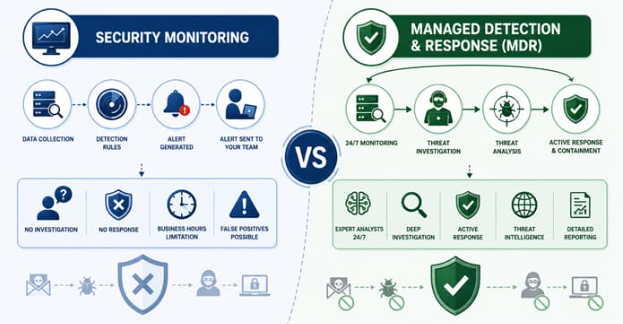
Security monitoring and Managed Detection and Response are not the same thing - but many businesses treat them as if they are. Both involve watching your systems for threats, but the similarity ends there. One generates alerts. The other investigates them, determines whether they represent a real threat, and takes action to stop it.
For organizations in Saudi Arabia operating under PDPL KSA enforcement, this distinction matters significantly. PDPL requires organizations to have adequate technical security controls in place - and the ability to detect and respond to breaches within 72 hours. Understanding what monitoring can and cannot deliver is essential for making the right security investment.
What this article covers:
What security monitoring is and what it does
What Managed Detection and Response (MDR) is and how it works
Key differences between MDR vs monitoring
Which approach is right for your organization
How MDR and monitoring relate to SIEM and SOC
Saudi Arabia and PDPL considerations
What Is Security Monitoring?
Security monitoring is the continuous observation of an organization's systems, networks, endpoints, and user activity to detect suspicious behavior and generate alerts. It is the foundation of any security program - without visibility into what is happening across your environment, threats cannot be identified.
What Security Monitoring Typically Includes
Log collection from servers, firewalls, endpoints, and applications
Network traffic analysis - identifying unusual patterns or connections
User activity monitoring - detecting anomalous behavior
Alert generation - notifying the security team when suspicious activity is detected
Dashboard visibility - providing an overview of system health and security events
Monitoring tools collect data, apply rules and detection logic, and produce alerts. What happens next depends entirely on who receives those alerts and what they do with them.
Limitations of Security Monitoring Alone
Security monitoring has one critical limitation - it stops at the alert. When a monitoring tool flags suspicious activity, it sends a notification. Someone must then:
Receive the alert
Determine whether it represents a real threat or a false positive
Investigate the source, scope, and nature of the activity
Decide what action to take
Execute containment or remediation
If your organization does not have a trained security team available to perform these steps - at any hour of the day or night - monitoring provides visibility without response capability. You can see that something is wrong. You may not be able to stop it.
What Is Managed Detection and Response (MDR)?
Managed Detection and Response is a fully managed security service that combines continuous monitoring with expert-led threat investigation, analysis, and active response. MDR is delivered by an external team of security analysts who watch your environment, investigate alerts, determine what is real, and take action to contain threats - on your behalf.
Core Components of MDR
24/7 monitoring: continuous observation across all systems and environments
Threat detection: advanced detection logic combining automated tools and human analysis
Alert investigation: security analysts review every alert to determine if it represents a genuine threat
Threat hunting: proactive searching for threats that automated tools may not catch
Active response: containing, isolating, and remediating confirmed threats
Threat intelligence: real-time information about current attack techniques and indicators of compromise
Reporting: regular reports on security posture, incidents, and response actions
How MDR Differs from Traditional Monitoring
The fundamental difference is human expertise and response capability. Monitoring watches and alerts. MDR watches, investigates, judges, and acts. An MDR provider does not just tell you that something suspicious happened - they determine whether it is a real threat and stop it before it causes damage.
MDR vs Monitoring - Key Differences
Aspect
Security Monitoring
MDR
Scope
Observes and generates alerts
Observes, investigates, and responds
Human involvement
Alerts sent to your internal team
Expert analysts investigate on your behalf
Response capability
None - your team must respond
Active containment and remediation included
Threat intelligence
Basic rule-based detection
Continuous, real-time threat intelligence
Investigation depth
Surface-level alert generation
Deep forensic investigation of every threat
Threat hunting
Not included
Proactive threat hunting by experienced analysts
Coverage hours
Business hours or basic 24/7 alerting
24/7 expert-led monitoring and response
False positive management
Your team must filter false positives
MDR analysts filter and investigate before escalating
Best suited for
Organizations with internal security teams
Organizations without dedicated security staff
Cost
Lower - tool cost only
Higher - but includes full investigation and response
What Security Monitoring Can and Cannot Do
What Monitoring Does Well
Security monitoring is highly effective at:
Providing continuous visibility across your environment
Generating alerts when detection rules are triggered
Collecting logs and security data for analysis and compliance reporting
Feeding data into a SIEM or security operations workflow
Supporting compliance documentation requirements under PDPL KSA
For organizations with a capable internal security team, monitoring is an essential input. It gives analysts the data they need to identify and investigate threats.
Where Monitoring Falls Short
Monitoring cannot:
Determine whether an alert represents a real threat or a false positive
Investigate the source, scope, or impact of suspicious activity
Contain a threat that is actively spreading through your network
Respond to incidents outside business hours without on-call staff
Proactively hunt for threats that have not yet triggered a detection rule
The Alert Fatigue Problem
One of the most significant challenges with security monitoring is alert volume. Modern environments generate thousands of security events daily. Without experienced analysts to filter and prioritize, organizations are quickly overwhelmed - leading to alert fatigue where critical threats are missed among the noise.
MDR providers address this directly. Their analysts filter false positives, prioritize genuine threats, and escalate only what requires action - dramatically reducing the burden on your internal team while improving response accuracy.
What MDR Can and Cannot Do
What MDR Does Well
MDR is highly effective at:
Providing 24/7 expert-led monitoring without requiring in-house security staff
Investigating every alert to determine genuine threats from false positives
Containing active threats before they cause significant damage
Proactively hunting for threats that automated tools may miss
Providing rapid breach response - critical for PDPL's 72-hour notification requirement
Delivering detailed reporting for compliance and governance purposes
Where MDR Has Limitations
MDR works best when combined with good organizational security practices. It is not a substitute for:
Security awareness training: MDR cannot prevent employees from clicking phishing links
Vulnerability management: MDR detects exploitation attempts but cannot patch unpatched systems
Access control policies: MDR monitors access but cannot enforce least privilege if it is not configured
PDPL compliance documentation: MDR supports compliance but does not replace a full compliance program
When MDR Is the Right Choice
MDR is the right choice when:
Your organization does not have a dedicated internal security team
You need 24/7 coverage that your internal team cannot provide
You have experienced alert fatigue and need expert investigation
A breach would cause significant operational, financial, or regulatory damage
You need to meet PDPL KSA's breach detection and notification requirements
MDR vs SIEM vs SOC - Understanding the Difference
Organizations evaluating security options frequently encounter multiple terms that overlap. Understanding how they relate helps in making the right investment decision.
Solution
What It Does
Who Operates It
Security Monitoring
Collects data and generates alerts
Automated tools
SIEM
Aggregates and correlates logs - produces prioritized alerts
Automated, but requires human analysts
SOC
Internal team that monitors, investigates, and responds
Your own security staff
MDR
External experts who monitor, investigate, AND respond
External security provider
Do You Need All of These?
Not necessarily. The right combination depends on your organization's size, internal capabilities, and risk profile.
A small business with no security team needs MDR - it replaces the need for an internal SOC
A large enterprise with an internal SOC may use monitoring and SIEM to feed their analysts, with MDR for after-hours coverage or specialized threat hunting
A mid-market organization may use MDR as a cost-effective alternative to building and staffing a full SOC
How MDR Replaces or Complements a SOC
For organizations without an internal SOC, MDR effectively serves the same function - providing expert monitoring, investigation, and response capability. For organizations with an existing SOC, MDR can complement internal teams by providing threat hunting, specialized expertise, or extended coverage hours.
MDR vs Monitoring for Saudi Businesses - PDPL Considerations
For organizations operating in Saudi Arabia, the choice between MDR and basic monitoring has direct implications for PDPL KSA compliance.
PDPL Article 19 - Technical Security Controls: PDPL requires organizations to implement appropriate technical security measures proportionate to the sensitivity of the data they process. MDR can support Article 19 compliance by strengthening monitoring, investigation, and incident-response capability, but organizations still need broader technical and organizational measures appropriate to the sensitivity of the data they process.
72-Hour Breach Notification: PDPL requires organizations to notify SDAIA within 72 hours of discovering a personal data breach. Basic monitoring can detect that something suspicious has occurred - but without MDR-level investigation, determining whether a breach has actually taken place, what data was affected, and what the scope of the incident is takes significantly longer.
MDR providers investigate incidents in real time, dramatically reducing the time between detection and confirmed breach identification - making it far more feasible to meet SDAIA's 72-hour notification deadline.
NCA ECC Alignment: Where NCA cybersecurity controls apply, continuous monitoring is an important element of cybersecurity capability. MDR can help organizations operationalize monitoring and incident handling, but applicability of NCA controls depends on the organization’s scope and regulatory position.
SDAIA Audit Readiness: MDR services provide detailed incident logs, investigation records, and response documentation - all of which support SDAIA audit readiness and demonstrate operational compliance with PDPL's technical requirements.
How to Evaluate an MDR Provider
When assessing MDR providers, Saudi businesses should evaluate the following:
24/7 coverage confirmation: verify that expert analysts are available at all hours, not just automated alerting
Response time SLAs: how quickly does the provider investigate and respond to confirmed threats?
Active containment capability: can the provider isolate affected systems, block malicious traffic, and take remediation action - or do they only advise?
Threat intelligence sources: what threat intelligence feeds and research does the provider use to stay current on emerging attack techniques?
False positive management: how does the provider filter noise and ensure only genuine threats are escalated?
Reporting and transparency: what visibility do you have into what the provider is doing on your behalf?
Saudi Arabia and PDPL experience: does the provider understand NCA ECC requirements, SDAIA enforcement priorities, and local compliance obligations?
How CyberRT Helps With Threat Detection and Response
CyberRT provides managed cybersecurity services designed for organizations operating in Saudi Arabia. Our threat detection and response capabilities are built around PDPL KSA requirements and NCA ECC alignment - ensuring that your security program meets both operational and regulatory standards.
Our services include:
Managed cybersecurity services: continuous monitoring and expert-led threat detection
Active threat response: investigation, containment, and remediation by experienced analysts
Breach response planning: documented procedures aligned with PDPL's 72-hour SDAIA notification requirement
NCA ECC technical controls: implementation of technical and organizational security measures that support PDPL Article 19 compliance, where applicable.
PDPL compliance support: ensuring your security program meets Saudi Arabia's data protection requirements
Security awareness training: reducing the human-driven risks that monitoring and MDR cannot address alone
Frequently Asked Questions
Q1: What is the difference between MDR and security monitoring?
Security monitoring collects data and generates alerts when suspicious activity is detected. MDR goes further - expert analysts investigate every alert, determine whether it is a genuine threat, and take active steps to contain and remediate confirmed incidents. Monitoring provides visibility. MDR provides visibility plus response.
Q2: Does my business need MDR or basic monitoring?
If your organization has a dedicated internal security team to investigate alerts and respond to incidents, basic monitoring may be sufficient. If you lack internal security expertise or cannot provide 24/7 response coverage, MDR delivers monitoring, investigation, and response without requiring in-house staff.
Q3: Is MDR the same as a SOC?
Not exactly. A SOC is an internal security operations center staffed by your own employees. MDR is a managed external service that provides the same monitoring, investigation, and response capabilities without requiring you to build and staff an internal team. For many organizations, MDR is a more cost-effective alternative to building a full SOC.
Q4: How does MDR help with PDPL compliance?
MDR can support PDPL compliance by improving monitoring, investigation, and incident-response capability, which may help organizations meet Article 19 obligations and handle reportable breaches more effectively. It also helps organizations meet the 72-hour breach notification deadline by accelerating breach identification and scope assessment through expert-led investigation.
Q5: What should I look for in an MDR provider?
Key factors include 24/7 expert coverage, confirmed active response capability, clear SLAs for investigation and containment, transparent reporting, strong threat intelligence, and experience with Saudi Arabia's regulatory requirements including PDPL KSA and NCA ECC standards.