This guide is provided for general informational purposes only and does not constitute legal advice. PDPL obligations may vary based on your role (controller/processor), sector requirements, and your specific processing activities. For formal interpretation or legal decisions, consult qualified counsel and refer to official SDAIA/NDMO regulations and guidance
The rapid expansion of digital services in Saudi Arabia has significantly increased the volume of personal data being generated, stored, and processed every day. Businesses across industries now rely on digital platforms that collect and manage sensitive information from customers, employees, and partners.
As organizations adopt technologies such as cloud computing, online payment systems, and digital platforms, the amount of personal data flowing through these systems continues to grow. This creates new opportunities for innovation and economic growth, but it also increases the risks associated with data misuse, cyber threats, and privacy violations.
To address these concerns and strengthen digital trust, Saudi Arabia introduced Saudi PDPL (Personal Data Protection Law). This regulation establishes the legal framework that governs how organizations collect, process, store, and share personal data.
Why Data Protection Matters
In a modern digital economy, personal data is one of the most valuable assets for organizations. However, without proper safeguards, personal information can be exposed, misused, or exploited.
Effective data protection laws help to:
- Protect individuals’ privacy and personal information
- Ensure organizations handle data responsibly
- Reduce risks of data breaches and cyber incidents
- Build trust between businesses and customers
- Strengthen confidence in digital services
By setting clear standards for data processing, Saudi PDPL helps ensure that businesses operate responsibly while protecting the rights of individuals.
Role of Saudi PDPL in the Kingdom
Saudi PDPL serves as the primary data protection law KSA, establishing rules that organizations must follow when handling personal data.
The law aims to:
- Regulate the collection and processing of personal data
- Ensure transparency in how data is used
- Protect individuals from unauthorized use of their information
- Promote secure and ethical data management practices
This regulatory framework supports Saudi Arabia’s broader digital transformation initiatives and aligns the Kingdom with global data protection trends.
Why Businesses Must Understand Saudi PDPL
Organizations operating in Saudi Arabia must understand how the law affects their operations. Whether a company collects customer information, manages employee records, or operates digital platforms, it is likely processing personal data.
Failure to understand and comply with Saudi PDPL can expose businesses to regulatory penalties, operational risks, and reputational damage.
What Is Saudi PDPL?
Saudi PDPL refers to the Personal Data Protection Law of Saudi Arabia, a national regulation that governs how organizations collect, process, store, and transfer personal data. The law establishes clear rules for businesses, government entities, and organizations that handle personal information belonging to individuals in the Kingdom.
As digital services continue to expand across industries such as finance, healthcare, e-commerce, and cloud technology, organizations are processing increasing amounts of personal information. Saudi PDPL provides the legal framework that ensures this data is handled responsibly, securely, and transparently.
By introducing clear data protection standards, the law strengthens privacy rights while promoting trust in digital platforms and online services.
Definition of Saudi PDPL
The Saudi Personal Data Protection Law (PDPL) is the primary legislation that regulates the processing of personal data within Saudi Arabia. It sets out the legal obligations organizations must follow when handling personal information.
Under Saudi PDPL, organizations must ensure that personal data is:
- Collected for legitimate and lawful purposes
- Processed in a transparent and responsible manner
- Stored securely with appropriate protection measures
- Used only for clearly defined purposes
- Not retained longer than necessary
This framework ensures that individuals maintain control over their personal information while organizations operate within defined legal boundaries.
Purpose of the Law
The introduction of Saudi PDPL reflects Saudi Arabia’s commitment to strengthening data governance and protecting individual privacy in a rapidly growing digital economy.
The law was designed to achieve several key objectives.
Protect Personal Data of Individuals
The primary purpose of the law is to safeguard the personal information of individuals residing in Saudi Arabia. It ensures that organizations respect privacy rights and prevent misuse of personal data.
Ensure Responsible Data Processing
Organizations must process personal data ethically and lawfully. This includes obtaining consent where required, limiting data collection, and implementing appropriate security safeguards.
Strengthen Digital Trust
Trust is essential for digital services to succeed. By regulating how personal data is handled, Saudi PDPL helps build confidence among consumers, employees, and business partners.
Support Saudi Arabia’s Digital Economy
Saudi Arabia is undergoing rapid digital transformation under Vision 2030. Strong data protection regulations encourage innovation while ensuring that technological progress does not compromise privacy and security.
Scope of Saudi PDPL
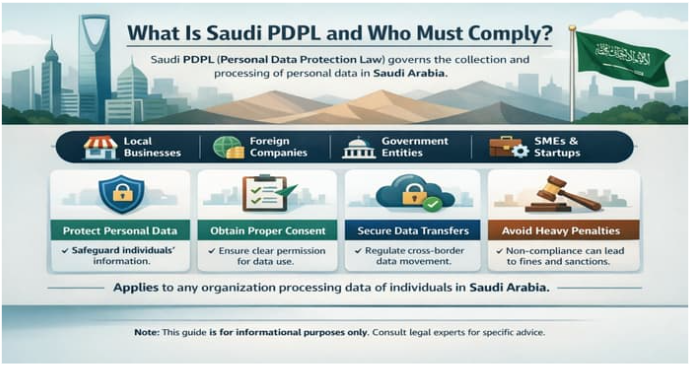
The scope of Saudi PDPL is broad and applies to any organization that processes personal data within Saudi Arabia.
This includes:
- Private companies
- Government entities
- Small and medium-sized businesses
- International companies operating in the Kingdom
- Organizations processing personal data of individuals residing in the Kingdom.
Even businesses located outside Saudi Arabia may fall under the law if they process personal data related to individuals living in the Kingdom.
The regulation covers all stages of data handling, including:
- Data collection
- Storage and processing
- Data sharing with third parties
- Cross-border data transfers
Through these provisions, Saudi PDPL establishes the legal framework for personal data protection under the data protection law KSA, ensuring organizations manage personal information responsibly and securely.
Why Saudi PDPL Was Introduced
Saudi Arabia has experienced rapid digital growth over the past decade. Businesses, government services, and everyday consumer activities are increasingly shifting to online platforms. While this digital transformation brings convenience and economic opportunity, it also increases the amount of personal data being collected, stored, and processed by organizations.
To address these changes and ensure responsible handling of personal information, the Kingdom introduced Saudi PDPL, the national framework governing personal data protection under the data protection law KSA. The law was designed to strengthen privacy safeguards while supporting the country’s evolving digital economy.
Below are the key factors that led to the introduction of Saudi PDPL.
Rapid Digital Transformation in Saudi Arabia
Saudi Arabia is undergoing a major digital transformation as part of its long-term economic development strategy. Government initiatives, smart city projects, and digital public services have significantly increased the use of online platforms.
Many services that were once handled manually are now digital, including:
- Government services and e-portals
- Online banking and financial services
- Digital healthcare platforms
- Cloud-based enterprise systems
- Online education and learning platforms
As these systems collect large volumes of personal information, it became necessary to introduce regulations that ensure personal data is managed securely and responsibly.
Saudi PDPL helps create a structured legal environment where organizations can innovate digitally while maintaining strong privacy protections.
Growth of E-Commerce and Fintech
The rapid expansion of e-commerce and fintech platforms has also played a major role in the need for stronger data protection laws.
Online marketplaces, digital payment systems, and financial applications now process vast amounts of personal and financial data. This includes:
- Customer identity information
- Payment details
- Transaction histories
- Delivery addresses
- Behavioral purchasing data
Without clear regulations, businesses could potentially misuse or mishandle such information.
By implementing Saudi PDPL, the Kingdom ensures that organizations handling financial and consumer data operate under defined privacy and security standards.
This regulation helps create a safer digital marketplace while increasing trust among consumers and businesses.
Increase in Cybersecurity Risks
As digital systems expand, the risk of cyber threats and data breaches also increases. Organizations that store large volumes of personal data can become targets for cybercriminals seeking to access sensitive information.
Common risks include:
- Data breaches exposing personal records
- Unauthorized access to digital systems
- Identity theft and financial fraud
- Misuse of customer data
The introduction of Saudi PDPL helps mitigate these risks by requiring organizations to implement proper security safeguards and responsible data management practices.
By enforcing structured data protection requirements, the law encourages organizations to adopt stronger cybersecurity measures and improve their overall data governance frameworks.
Need for Stronger Privacy Protection
Individuals today are more aware of how their personal data is collected and used. Consumers expect transparency from organizations regarding how their information is processed, stored, and shared.
Before the introduction of Saudi PDPL, privacy protections were not regulated under a single comprehensive framework.
The law was introduced to ensure that individuals have stronger rights over their personal information, including:
- The right to know how their data is used
- The right to access their personal data
- The right to request correction of inaccurate information
- The right to request deletion in certain circumstances
These protections strengthen privacy rights while ensuring organizations operate with transparency and accountability.
Alignment with Global Privacy Regulations
Another important reason for introducing Saudi PDPL was to align Saudi Arabia with global data protection standards.
Many countries have already implemented strong privacy regulations, such as:
- GDPR in the European Union
- CCPA in California
- Data protection frameworks in the UAE and other regions
By establishing its own comprehensive data protection law KSA, Saudi Arabia ensures that its regulatory environment meets international expectations.
This alignment benefits businesses in several ways:
- Facilitates international data transfers
- Builds trust with global partners
- Supports foreign investment
- Enables cross-border digital services
Organizations operating internationally often prefer jurisdictions with clear and modern data protection laws. Saudi PDPL helps position the Kingdom as a secure and trusted digital economy.
Supporting Saudi Arabia’s Digital Future
Ultimately, the introduction of Saudi PDPL reflects Saudi Arabia’s commitment to building a secure, transparent, and trusted digital environment.
By regulating how personal data is handled, the law:
- Protects individuals’ privacy
- Encourages responsible innovation
- Strengthens cybersecurity practices
- Supports long-term digital economic growth
As the Kingdom continues to expand its digital infrastructure and online services, Saudi PDPL plays a critical role in ensuring that personal data protection remains a central part of this transformation.
Who Must Comply With Saudi PDPL
Understanding who must comply with Saudi PDPL is essential for organizations operating in or interacting with the Saudi market. The law has a broad scope and applies to any entity that collects, processes, stores, or transfers personal data related to individuals in Saudi Arabia.
Compliance is not limited to large corporations. The data protection law KSA applies to a wide range of organizations across both the public and private sectors. Any organization that handles personal data must evaluate whether its activities fall within the scope of the law.
Below are the main categories of entities that must comply with Saudi PDPL.
Businesses Operating in Saudi Arabia
All businesses operating within Saudi Arabia that process personal data are required to comply with Saudi PDPL. This includes companies that collect, store, or analyze information about customers, employees, vendors, or website users.
Examples of businesses that typically process personal data include:
- Retail companies collecting customer contact details
- E-commerce platforms storing customer accounts and purchase history
- Banks and financial institutions handling financial records
- Healthcare providers managing patient information
- Employers maintaining employee records and payroll data
Even basic activities such as maintaining customer databases, processing online orders, or managing employee files involve handling personal data. Therefore, organizations performing these activities must follow the requirements of the data protection law KSA.
Businesses must ensure that personal data is collected for legitimate purposes, processed securely, and protected from unauthorized access or misuse.
Foreign Companies Processing Saudi Residents’ Data
Saudi PDPL also has an extraterritorial scope, meaning the law may apply to organizations located outside Saudi Arabia if they process personal data belonging to individuals residing in the Kingdom.
This provision ensures that companies cannot avoid compliance simply by operating from another country while still targeting individuals residing in the Kingdom.
Foreign companies that may fall under the scope of Saudi PDPL include:
- Software-as-a-Service (SaaS) providers offering platforms to Saudi customers
- International e-commerce businesses selling products to Saudi consumers
- Cloud service providers hosting personal data belonging to Saudi users
- Online service platforms collecting user information from individuals residing in the Kingdom.
For example, a foreign SaaS platform that stores customer data for Saudi businesses may still be required to comply with the data protection law KSA, even if its servers or headquarters are located abroad.
Organizations serving the Saudi market must therefore evaluate their data processing activities and determine whether the law applies to them.
Government and Public Entities
Government institutions and public sector organizations are also required to comply with Saudi PDPL when handling personal data.
Public entities often process large volumes of sensitive information related to citizens and residents. This may include:
- National identification records
- Government service applications
- Healthcare and insurance information
- Employment records
- Licensing and regulatory data
Because of the sensitive nature of this information, government organizations must ensure that personal data is processed securely and used only for legitimate administrative purposes.
The inclusion of public sector entities within the scope of Saudi PDPL helps ensure consistent data protection standards across both government and private organizations.
SMEs and Startups
Small and medium-sized enterprises (SMEs) and startups are also required to comply with Saudi PDPL if they process personal data.
Some small businesses mistakenly believe that data protection regulations apply only to large companies. However, the data protection law KSA applies regardless of company size. The determining factor is whether the organization handles personal data.
Examples of SMEs and startups that may process personal data include:
- Online stores collecting customer orders and contact information
- Marketing agencies managing client databases
- Technology startups operating mobile apps or digital platforms
- Service providers storing customer contact details
Even simple activities such as collecting email addresses for newsletters or maintaining customer contact lists involve personal data processing.
Although smaller organizations may implement simpler compliance structures compared to large enterprises, they must still follow the fundamental principles of Saudi PDPL, including transparency, lawful processing, and data security.
Why Understanding Compliance Scope Is Important
Many organizations underestimate whether the law applies to them. However, Saudi PDPL is designed to cover a wide range of data processing activities, ensuring that personal data is protected regardless of where or by whom it is processed.
Businesses that determine early whether they fall within the scope of the law can take proactive steps to implement compliance measures, reduce regulatory risks, and build stronger trust with customers and partners.
What Types of Data Are Covered Under Saudi PDPL
Under Saudi PDPL, personal data refers to any information that can identify an individual either directly or indirectly. The data protection law KSA applies whenever organizations collect, store, process, or share information that can be linked to a specific person.
Personal data is not limited to obvious identifiers such as names or identification numbers. Even digital identifiers and behavioral information can fall within the scope of the law if they can be associated with an individual.
Organizations that process such information must ensure that it is handled responsibly, securely, and only for legitimate purposes defined under Saudi PDPL.
Examples of Personal Data
Personal data includes a wide range of information used to identify or relate to an individual. Some common examples include:
- Name
- National ID Number
- Email Address
- Phone Number
- Financial Data
- Health Records
- IP Address
These types of information are commonly processed by organizations across industries such as e-commerce, banking, healthcare, and digital services. Because this data can identify individuals, it falls under the protection of Saudi PDPL.
Sensitive Personal Data
In addition to general personal data, Saudi PDPL also recognizes certain categories of information as sensitive personal data. This type of data requires stronger protection and stricter handling procedures.
Sensitive personal data may include:
- Health and medical information
- Biometric identifiers such as fingerprints or facial recognition data
- Genetic information
- Religious or belief-related data
- Any other information considered highly private or sensitive
Because misuse or unauthorized disclosure of sensitive personal data can cause significant harm to individuals, organizations must apply enhanced security measures and stricter processing controls when handling such information.
Why Identifying Data Types Is Important
Understanding what qualifies as personal data is an important step in achieving compliance with Saudi PDPL. Organizations must clearly identify what types of data they collect and process in order to apply appropriate security measures and comply with regulatory requirements.
Businesses that properly classify and manage personal data can better protect individuals’ privacy while ensuring compliance with the data protection law KSA.
Key Responsibilities Under Saudi PDPL
Organizations that fall within the scope of Saudi PDPL must follow certain responsibilities when handling personal data. These obligations are designed to ensure that personal information is processed lawfully, securely, and transparently.
The data protection law KSA requires businesses to implement basic governance measures that protect individuals’ privacy and prevent misuse of personal data. While the exact compliance requirements may vary depending on the organization and the type of data processed, several core responsibilities apply to most entities.
Below are some of the key responsibilities organizations must follow under Saudi PDPL.
Obtain Lawful Basis or Consent
Organizations must have a legitimate reason for collecting and processing personal data. In many cases, this requires obtaining clear consent from individuals before collecting their information.
Consent should be:
- Clearly communicated
- Freely given by the individual
- Related to a specific purpose
Organizations should also ensure that individuals understand how their data will be used and provide them with the option to withdraw consent when applicable.
Protect Personal Data With Security Controls
Businesses must implement appropriate security measures to protect personal data from unauthorized access, loss, or misuse.
Basic security practices may include:
- Access control systems
- Data encryption
- Secure storage systems
- Monitoring and detection tools
These safeguards help reduce the risk of data breaches and ensure that personal information remains protected throughout its lifecycle.
Respect Data Subject Rights
Individuals have certain rights regarding their personal data under Saudi PDPL. Organizations must respect these rights and provide mechanisms that allow individuals to exercise them.
These rights may include:
- Accessing their personal data
- Requesting correction of inaccurate information
- Requesting deletion in certain circumstances
- Understanding how their data is being processed
Organizations should have clear procedures in place to respond to such requests.
Limit Data Collection
Another important responsibility under the data protection law KSA is the principle of data minimization. Organizations should only collect personal data that is necessary for a specific and legitimate purpose.
Collecting excessive or irrelevant information increases privacy risks and may violate regulatory requirements. Businesses should review their data collection practices regularly to ensure that only essential data is gathered.
Manage Cross-Border Data Transfers
If personal data needs to be transferred outside Saudi Arabia, organizations must ensure that appropriate safeguards are in place.
Businesses should evaluate:
- Where personal data is being stored
- Whether foreign service providers handle personal information
- Whether adequate protection measures exist for international transfers
Managing cross-border transfers responsibly helps ensure that personal data remains protected even when processed outside the Kingdom.
By following these responsibilities, organizations can build a strong foundation for compliance with Saudi PDPL and demonstrate responsible data management practices.
Consequences of Non-Compliance
Failing to comply with Saudi PDPL can expose organizations to several serious risks. The data protection law KSA was introduced to protect personal information and ensure responsible data processing. Organizations that ignore these requirements may face regulatory, legal, and business consequences that can significantly impact their operations.
Below are some of the key risks associated with non-compliance.
Regulatory Penalties
Organizations that violate Saudi PDPL may face regulatory actions from the relevant authorities. These actions can include investigations, financial penalties, or enforcement measures designed to correct non-compliant practices.
Regulatory authorities may require organizations to:
- Stop certain data processing activities
- Implement corrective measures
- Improve data protection controls
- Submit compliance reports or documentation
Such enforcement actions can disrupt operations and increase compliance costs for businesses.
Legal Consequences
Non-compliance with the data protection law KSA may also lead to legal consequences. Organizations that misuse personal data, fail to protect sensitive information, or process data unlawfully may face legal claims or disputes.
Legal risks can arise from:
- Unauthorized use of personal data
- Failure to obtain proper consent
- Negligence in protecting sensitive information
- Improper data sharing with third parties
These issues can result in legal proceedings, compensation claims, or additional regulatory scrutiny.
Reputational Damage
Beyond regulatory penalties, data protection failures can damage an organization’s reputation. Customers and partners expect businesses to handle personal data responsibly. A data breach or misuse of personal information can quickly undermine trust.
Reputational damage may lead to:
- Negative media attention
- Loss of business partnerships
- Reduced customer confidence
Recovering from such damage can take significant time and effort.
Loss of Customer Trust
Trust is a critical factor in today’s digital economy. Customers share personal information with organizations expecting that it will be handled securely and responsibly.
When businesses fail to comply with Saudi PDPL, customers may lose confidence in how their data is managed. This can result in:
- Decreased customer engagement
- Higher customer churn
- Reduced willingness to share personal information
Maintaining compliance with the data protection law KSA helps organizations build long-term trust with customers and ensures responsible handling of personal data.
How Businesses Can Start PDPL Compliance
Starting Saudi PDPL compliance does not always require complex systems at the beginning. What matters most is understanding how personal data flows within the organization and putting basic governance measures in place. Businesses should begin by identifying where personal data is collected, how it is used, and who has access to it. This foundational step allows organizations to align their processes with the requirements of the data protection law KSA and gradually build a structured compliance framework.
Below are some practical steps businesses can take to begin their compliance journey.
Conduct Data Mapping
The first step toward compliance is understanding what personal data the organization collects and how it moves through internal systems. Data mapping helps businesses identify where personal information is stored, processed, or shared.
Organizations should document:
- What types of personal data they collect
- Where the data is stored
- Which departments access the data
- Whether the data is shared with third parties
Creating a clear data inventory helps businesses identify potential risks and ensures that personal data is processed in accordance with Saudi PDPL.
Review Privacy Policies
Businesses should review and update their privacy policies to ensure they clearly explain how personal data is collected and used. Privacy notices should be transparent and easy for individuals to understand.
A strong privacy policy should describe:
- What data is collected
- Why the data is collected
- How the data will be used
- Whether the data will be shared with third parties
- How individuals can exercise their rights
Updating privacy policies ensures that organizations remain transparent and aligned with the expectations of the data protection law KSA.
Strengthen Security Controls
Organizations must protect personal data from unauthorized access, loss, or misuse. Strengthening security controls is a key part of Saudi PDPL compliance.
Basic security practices may include:
- Implementing access control systems
- Using encryption for sensitive data
- Securing databases and storage systems
- Monitoring systems for suspicious activity
These measures help reduce the risk of data breaches and improve the organization’s overall cybersecurity posture.
Implement Consent Management
Many organizations collect personal data through websites, applications, or customer forms. In such cases, businesses must ensure that individuals understand how their data will be used and provide consent when required.
Effective consent management involves:
- Clearly informing individuals about data collection purposes
- Providing options to accept or decline data processing
- Recording and storing consent decisions
- Allowing individuals to withdraw consent when necessary
Implementing proper consent mechanisms helps businesses demonstrate responsible data practices and supports compliance with Saudi PDPL.
Conclusion
Saudi PDPL serves as the primary data protection law KSA, establishing the legal foundation for how personal data must be handled within the Kingdom. As businesses increasingly rely on digital systems and online services, protecting personal information has become a critical responsibility for organizations across all industries.
The law applies to a wide range of entities, including private companies, government organizations, startups, SMEs, and even foreign businesses that process data related to individuals residing in Saudi Arabia. Any organization that collects, stores, or processes personal information must understand its obligations under Saudi PDPL.
Complying with the law is not only about avoiding regulatory penalties. It is also about building trust with customers, partners, and employees. Organizations that follow responsible data protection practices demonstrate transparency, strengthen cybersecurity, and create a safer digital environment for everyone involved.
As Saudi Arabia continues its digital transformation, businesses should treat PDPL compliance as a core part of their operational strategy. Evaluating current data practices, improving security controls, and ensuring transparency in how personal data is handled are important steps toward meeting the requirements of the data protection law KSA and supporting sustainable digital growth.
Frequently Asked Questions
What does Saudi PDPL stand for?
Saudi PDPL stands for Personal Data Protection Law, which is the main regulation governing how personal data is collected, processed, stored, and shared in Saudi Arabia. It establishes rules that organizations must follow to protect individuals’ privacy and ensure responsible handling of personal information under the data protection law KSA.
Does Saudi PDPL apply to foreign companies?
Yes. Saudi PDPL can apply to foreign companies if they process personal data related to individuals residing in Saudi Arabia. This includes international businesses offering digital services, e-commerce platforms, or cloud solutions to Saudi customers. Even without a physical presence in the Kingdom, such organizations may still be required to comply.
What is considered personal data under Saudi PDPL?
Personal data under Saudi PDPL includes any information that can identify an individual directly or indirectly. Examples include names, national ID numbers, email addresses, phone numbers, IP addresses, financial data, and health records. Sensitive data such as medical or biometric information requires stronger protection.
Do small businesses need to comply with PDPL?
Yes. Saudi PDPL applies to businesses of all sizes, including SMEs and startups. If a small business collects or processes personal data such as customer contact details, employee records, or online user information, it must follow the requirements of the data protection law KSA to ensure responsible data handling.