In today’s digital-first environment, businesses rely heavily on cloud platforms, remote access, applications, and connected systems to operate efficiently. While this improves productivity and scalability, it also increases exposure to cyber threats such as ransomware, phishing attacks, and data breaches.
As cyber risks continue to evolve, organizations can no longer rely on a single security tool or basic protection setup. Instead, they need a structured approach that includes multiple layers of protection. This is where understanding the types of cybersecurity services becomes essential.
Cybersecurity services help businesses detect threats, protect systems, and respond to attacks before they cause serious damage. This guide explains the most important cybersecurity services every business should consider and how they work together to strengthen overall security.
What Are Cybersecurity Services?
Cybersecurity services are professional solutions designed to protect an organization’s systems, networks, applications, and data from cyber threats.
Unlike standalone tools, cybersecurity services can include continuous monitoring, threat detection, risk assessment, testing, and expert support, depending on the service model. They are typically delivered by internal security teams or external providers as part of a broader security strategy.
In simple terms, cybersecurity services help businesses:
- identify risks
- prevent attacks
- detect threats early
- respond effectively to incidents
They play a critical role in moving organizations from reactive security to a proactive and continuous protection model.
Why Businesses Need Different Types of Cybersecurity Services
No single security solution can protect an organization completely. Modern IT environments include networks, cloud systems, applications, users, and third-party integrations, each introducing different risks.
Because of this complexity, businesses need multiple cybersecurity services that work together as a layered defense strategy.
Different services address different risks:
- network-based threats
- application vulnerabilities
- cloud misconfigurations
- insider risks
- human error
By combining multiple services, organizations can build a stronger and more resilient security posture.
Core Types of Cybersecurity Services

Understanding the security services list below helps businesses choose the right combination based on their needs.
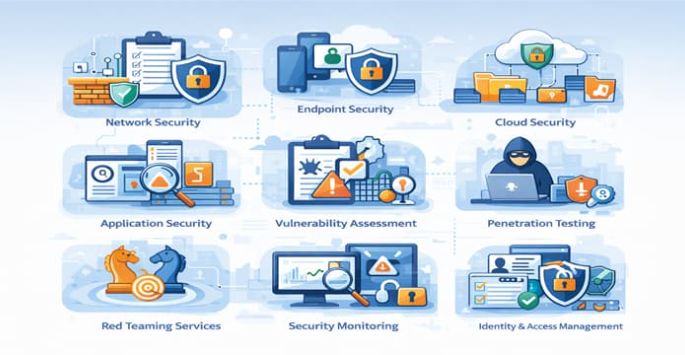
Network Security Services
Network security services focus on protecting internal and external network infrastructure from unauthorized access and attacks.
These services include:
- firewall management
- intrusion detection and prevention systems
- network traffic monitoring
- secure remote access
They act as a foundational layer of defense by helping control and inspect how traffic flows in and out of the organization.
Endpoint Security Services
Endpoint security services protect devices such as laptops, desktops, mobile phones, and servers.
Since endpoints are often targeted by attackers, these services help detect and block threats like malware and ransomware.
Key components include:
- antivirus and anti-malware tools
- endpoint detection and response (EDR)
- device monitoring
With remote work increasing, endpoint security has become more critical than ever.
Cloud Security Services
Cloud security services are designed to protect cloud-based systems, storage, and applications.
As businesses move to cloud platforms, risks such as misconfigurations and unauthorized access increase.
These services focus on:
- cloud configuration security
- access control
- activity monitoring
- data protection
Cloud security ensures that digital assets remain protected even in distributed environments.
Application Security Services
Application security services protect web applications, mobile apps, and APIs from vulnerabilities.
Since applications often handle sensitive data, attackers frequently target them.
These services help identify issues such as:
- weak authentication
- insecure APIs
- coding vulnerabilities
Regular testing and monitoring help prevent exploitation.
Vulnerability Assessment Services
Vulnerability assessment services identify known weaknesses in systems, networks, and applications and help prioritize remediation. They usually do not confirm exploitability in the same way penetration testing does..
These services typically involve:
- automated scanning
- vulnerability identification
- severity classification
They provide a clear view of security gaps and help prioritize fixes.
Penetration Testing Services
Penetration testing goes beyond scanning by simulating real-world attacks to validate whether vulnerabilities can actually be exploited.
It helps organizations:
- understand real risk exposure
- test defenses
- improve security controls
This service is especially useful for validating critical systems and applications.
Red Teaming Services
Red teaming is a more advanced security service that simulates realistic attacker behavior across the organization.
Unlike penetration testing, it evaluates:
- people
- processes
- technology
The goal is to test how well the organization can detect and respond to an actual attack.
Security Monitoring Services (SOC)
Security monitoring services provide continuous visibility into systems and user activity.
These services are usually delivered through a Security Operations Center (SOC) and include:
- log monitoring
- alert analysis
- threat detection
In many cases, providers offer 24/7 monitoring depending on the service model..
Incident Response Services
Incident response services help organizations handle security incidents quickly and effectively.
They focus on:
- detecting incidents
- containing threats
- recovering systems
- minimizing damage
A strong incident response capability reduces downtime and business impact.
Identity and Access Management (IAM)
IAM services help manage identity, authentication, authorization, and access control across systems and data.
They include:
- user authentication
- multi-factor authentication (MFA)
- role-based access control
- User provisioning and deprovisioning
- Access reviews
These services help prevent unauthorized access and reduce insider threats.
Data Protection Services
Data protection services focus on securing sensitive information from loss, theft, or exposure.
Key features include:
- data encryption
- backup solutions
- data loss prevention (DLP)
They ensure that critical business and customer data remains secure.
Compliance and Risk Management Services
These services help organizations meet regulatory requirements and manage cybersecurity risks effectively.
They involve:
- risk assessments
- compliance audits
- policy implementation
They are especially important for industries with strict regulations.
Security Awareness Training
Human error is one of the biggest cybersecurity risks. Security awareness training helps employees recognize threats such as phishing attacks and social engineering.
Training programs improve:
- user awareness
- safe behavior
- incident prevention
This service strengthens the human layer of security.
Managed Cybersecurity Services
Managed cybersecurity services provide ongoing security through an external provider.
These services include:
- continuous monitoring
- threat detection
- incident response support
They are especially useful for businesses without a full in-house security team, but they can also support larger organizations through co-managed or specialist services.
Cybersecurity Services List (Quick Overview)
| Service Type | Purpose | Best For |
| Network Security | Protect networks | All businesses |
| Endpoint Security | Protect devices | Remote teams |
| Cloud Security | Secure cloud | SaaS companies |
| Vulnerability Assessment | Identify weaknesses | Growing businesses |
| Penetration Testing | Validate risks | Tech teams |
| Red Teaming | Test resilience | Enterprises |
| Monitoring (SOC) | Detect threats | Scaling organizations |
How to Choose the Right Cybersecurity Services
Choosing the right cyber security solutions depends on several factors:
- business size and complexity
- type of data handled
- industry regulations
- risk exposure
- budget and resources
Organizations should focus on services that align with their most critical risks rather than adopting everything at once.
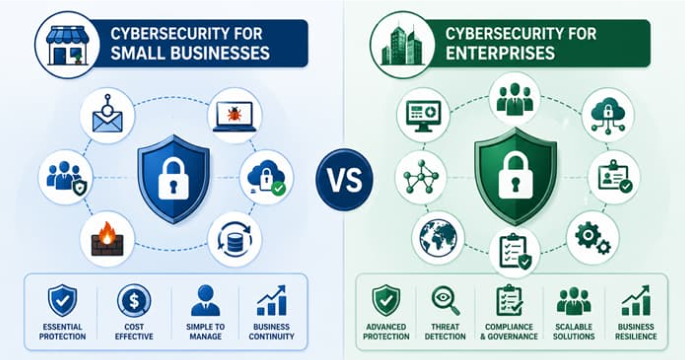
Cybersecurity Services by Business Size
Small Businesses
- endpoint security
- basic monitoring
- security awareness training
Mid-Sized Companies
- vulnerability management
- cloud security
- continuous monitoring
Enterprises
- red teaming
- advanced monitoring (SOC)
- compliance and governance
Common Cybersecurity Gaps Without These Services
Without proper cybersecurity services, organizations often face:
- lack of visibility
- delayed threat detection
- weak access controls
- unpatched systems
- poor incident response
These gaps increase the risk of cyber attacks and data breaches.
Benefits of Cybersecurity Services
Implementing the right services provides several advantages:
- improved protection against cyber threats
- faster detection and response
- better visibility into systems
- reduced risk exposure
- stronger compliance readiness
- cost-effective security management
These benefits help organizations operate more securely and confidently.
Future of Cybersecurity Services
Cybersecurity is rapidly evolving with new technologies and threats.
Key trends include:
- AI-driven threat detection
- automated response systems
- continuous risk monitoring
- cloud-first security strategies
Businesses that adopt modern cybersecurity services will be better prepared for future challenges.
Conclusion
Understanding the types of cybersecurity services is essential for building a strong and effective security strategy. No single solution can protect an organization completely. Instead, businesses need a combination of services that address different risks across systems, users, and data.
By implementing the right mix of cybersecurity services, organizations can reduce vulnerabilities, improve threat detection, and strengthen their overall resilience.
As cyber threats continue to grow, adopting a proactive and layered security approach is no longer optional. It is a critical part of long-term business success.
Frequently Asked Questions
Q1. What are the main types of cybersecurity services?
Common types include network security, endpoint security, cloud security, application security, vulnerability assessment, penetration testing, red teaming, monitoring, incident response, IAM, data protection, compliance support, awareness training, and managed services.
Q2. Do small businesses need cybersecurity services?
Yes, small businesses are often targeted and need basic protection such as endpoint security and monitoring.
Q3. What is the difference between tools and services?
Tools provide functionality, while services include monitoring, analysis, and expert support.
Q4. Which cybersecurity service is most important?
There is no single most important service. Businesses need a combination based on their risks.
Q5. Are managed cybersecurity services worth it?
Yes, they provide expert support, continuous monitoring, and cost-effective security for many organizations.