In today’s threat landscape, organizations face more cyber risk than ever before. Businesses rely heavily on cloud platforms, remote access, web applications, third-party tools, and connected systems to support daily operations. While this improves speed and flexibility, it also expands the attack surface and creates more opportunities for attackers to exploit weaknesses.
Traditional security controls still matter, but they are no longer enough on their own. Firewalls, antivirus tools, and compliance checks help create a security foundation, but they do not always show how well an organization can withstand a real-world attack. Modern threats are more targeted, persistent, and capable of exploiting technical gaps, weak processes, and human error.
This is why realistic security validation has become essential. Many organizations compare red teaming vs penetration testing when deciding how to assess their defenses. Although both are valuable security testing methods, they are built for different purposes.
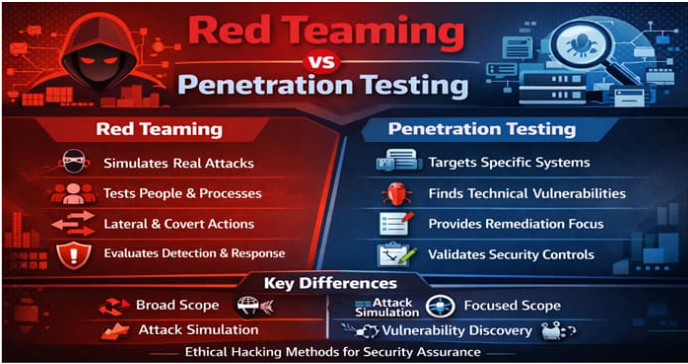
Penetration testing focuses on identifying and validating exploitable vulnerabilities in a defined system, application, or environment. Red teaming takes a broader approach by simulating realistic attacker behavior to test how well an organization’s people, processes, and technologies work together under pressure.
Understanding the difference matters. Choosing the wrong testing approach can leave important gaps in risk assessment. An organization may invest in a red team exercise before fixing basic technical weaknesses, or rely only on penetration testing when it really needs to evaluate detection, response, and operational resilience.
This guide explains how red teaming and penetration testing work, where they differ, what benefits they offer, and when each one makes the most sense.
Why Security Testing Matters for Modern Organizations
Modern organizations operate in highly connected digital environments. Business operations now depend on:
- cloud platforms
- remote access
- endpoints
- web applications
- internal networks
- third-party tools
As this digital footprint grows, the attack surface also expands. A weakness in any one area can create an entry point for attackers and expose sensitive data, business systems, or daily operations.
Security teams can no longer rely only on preventive controls. Firewalls, endpoint protection, and access controls remain important, but they do not always reveal how an environment will perform during a real attack.
Common security gaps often include:
- misconfigurations in systems or cloud environments
- exploitable software or application vulnerabilities
- weak access controls and privilege issues
- process failures in detection or response
- human error, phishing exposure, or poor security awareness
Security testing helps close this visibility gap. It allows organizations to validate whether weaknesses actually exist, whether they can be exploited, and how much risk they create in practice. This helps businesses find and fix issues before attackers take advantage of them.
A proactive testing strategy also supports stronger risk management by helping organizations:
- prioritize remediation
- improve incident readiness
- strengthen resilience
- understand where defenses are effective and where improvement is needed
This is where penetration testing and red teaming become valuable.
What Is Penetration Testing?

Penetration testing is a controlled security assessment in which testers attempt to circumvent or defeat security features and validate exploitable weaknesses in systems, applications, or networks. It is performed by authorized security professionals who simulate real-world attack techniques in a safe and structured way.
In simple terms, penetration testing helps organizations move beyond assumptions. Instead of relying only on automated scans or security tools, it tests whether a weakness can actually be used by an attacker. This gives businesses a clearer picture of their real exposure and helps them prioritize remediation more effectively.
What Penetration Testing Typically Covers
Depending on the engagement scope, penetration testing can cover:
- web applications
- APIs
- internal networks
- external networks
- wireless infrastructure
- cloud environments
- mobile applications
- access controls
Objectives of Penetration Testing
The main purpose of penetration testing is to help organizations understand where technical weaknesses exist and how serious they are. A typical engagement is designed to:
- identify technical vulnerabilities
- validate whether weaknesses are exploitable
- assess the severity and potential impact of findings
- provide remediation guidance
- support compliance and risk management efforts
When Organizations Usually Need Penetration Testing
Organizations usually need penetration testing in situations such as:
- before launching a new product or application
- after major infrastructure or network changes
- to support compliance requirements
- after cloud migration or major system updates
- during annual security reviews
- when validating the security of critical business systems
Penetration testing is one of the most practical security testing methods for organizations that need a focused assessment of real technical risk.
What Is Red Teaming?

Red teaming is an adversarial security exercise conducted under realistic conditions to assess how well an organization’s people, processes, and technologies can withstand, detect, and respond to attacker behavior. Unlike narrower technical assessments, red teaming is designed to test not only security technologies, but also the people, internal processes, and detection and response capabilities that support the overall security program.
Red teaming goes beyond simply finding vulnerabilities in a single system. Its purpose is to imitate real attacker behavior, follow realistic attack paths, and evaluate whether the organization can detect, contain, and respond before serious damage occurs.
What Red Teaming Typically Includes
Depending on the rules of engagement and business goals, red teaming may include:
- social engineering
- phishing simulation
- lateral movement across systems
- stealth tactics to avoid detection
- privilege escalation
- physical access attempts where permitted
- evasion of defensive controls
- testing blue team detection and response
Objectives of Red Teaming
A red team exercise is typically used to:
- measure real-world resilience
- test detection and response maturity
- identify gaps across people, processes, and tools
- validate how well the organization can withstand a realistic attack chain
When Organizations Usually Need Red Teaming
Red teaming is usually most valuable for organizations that already have a mature security foundation. Common situations include:
- mature security programs
- organizations with SOC, SIEM, or EDR capabilities
- critical infrastructure environments
- finance, healthcare, and enterprise organizations
- organizations that already perform baseline security testing
Red teaming provides a more realistic picture of whether existing controls, monitoring, and response processes are truly effective.
Red Teaming vs Penetration Testing: Core Differences
When comparing red teaming vs penetration testing, the main difference is the goal.
Penetration testing is mainly used to identify and validate exploitable weaknesses in a defined target. Red teaming is designed to simulate realistic attacker behavior and measure how well the organization can detect, respond to, and withstand a broader attack scenario.
Key Differences
Scope
Penetration testing usually has a clearly defined scope and focuses on specific systems, applications, APIs, cloud environments, or networks. Red teaming has broader objectives and may involve multiple attack paths, user interactions, and security layers.
Goal
Penetration testing focuses on finding vulnerabilities, confirming exploitability, and providing remediation guidance. Red teaming focuses on testing overall defensive readiness under realistic conditions.
Visibility
Penetration tests are often transparent and coordinated with internal teams. Red teaming is generally more covert so the organization can measure realistic detection and response.
Depth of Simulation
Penetration testing validates weaknesses in a controlled way. Red teaming goes further by simulating a wider attack chain, including initial access, lateral movement, privilege escalation, persistence, and post-exploitation activity.
Coverage
Penetration testing is primarily technical. Red teaming also evaluates people, internal processes, monitoring practices, escalation workflows, and response coordination.
Outcome
Penetration testing usually produces a findings-based report with vulnerabilities, severity levels, and remediation recommendations. Red teaming usually provides broader insight into attack paths, detection failures, response delays, and resilience gaps.
Red Teaming vs Penetration Testing Comparison Table
| Factor | Penetration Testing | Red Teaming |
| Main purpose | Identify and validate exploitable vulnerabilities | Simulate realistic attacker behavior |
| Scope | Narrow and clearly defined | Broad and goal-driven |
| Testing style | Targeted and controlled | Covert and adversarial |
| Focus | Systems, applications, networks, technical weaknesses | People, processes, detection, and security operations |
| Visibility | Usually coordinated | Often limited disclosure |
| Depth | Controlled validation of weaknesses | Full attack-chain simulation |
| Outcome | Findings and remediation guidance | Attack path and response readiness insights |
| Best for | Technical validation and compliance support | Advanced security maturity testing |
| Detection testing | Limited | Central objective |
| Security maturity needed | Suitable for many maturity levels | Better for mature security programs |
In simple terms, penetration testing is best for validating technical weaknesses, while red teaming is best for testing broader readiness across people, processes, and technology.
Ethical Hacking vs Red Team

Ethical hacking and red teaming are related, but they are not the same. Both involve authorized offensive security testing, but the difference comes down to scope, realism, and purpose.
Ethical hacking is a broad umbrella term for authorized hacking activities performed to improve security. Penetration testing is one of the most common forms of ethical hacking. It focuses on specific targets and validates whether vulnerabilities can be exploited.
Red teaming also falls under the broader category of ethical hacking, but it is more strategic and realistic. Instead of only testing whether a technical weakness exists, it simulates how a real attacker might move through an environment while avoiding detection and targeting meaningful business assets.
Ethical Hacking vs Red Team: Key Differences
- Breadth: Ethical hacking may focus on a specific system or issue, while red teaming usually has a broader scope.
- Realism: Ethical hacking often validates weaknesses in a controlled way, while red teaming simulates real attacker behavior.
- Stealth: Standard ethical hacking is usually more transparent, while red teaming often uses stealth.
- Objectives: Ethical hacking focuses on uncovering weaknesses. Red teaming focuses on testing detection, containment, and response.
- Reporting style: Ethical hacking usually produces technical findings. Red teaming produces broader insight into resilience and operational gaps.
Common Security Testing Methods Organizations Should Know
Organizations use different security testing methods based on their risk level, security maturity, and business goals. Not every method serves the same purpose.
Vulnerability Assessment
A vulnerability assessment is used to identify known weaknesses in systems, applications, networks, or cloud environments before attackers can exploit them.
It helps organizations:
- identify known weaknesses
- review severity levels
- prioritize remediation needs
- support regular reassessment
Penetration Testing
Penetration testing validates whether vulnerabilities can actually be exploited in a real-world scenario.
It is useful when an organization wants to:
- confirm whether a weakness is exploitable
- understand real business impact
- test specific systems or applications
- receive actionable remediation guidance
Red Teaming
Red teaming simulates how a real attacker might compromise an organization across a broader environment.
It is commonly used to evaluate:
- attacker behavior across multiple layers
- detection and response effectiveness
- gaps in people, processes, and technology
- overall resilience under realistic conditions
Purple Teaming
Purple teaming is a collaborative exercise that brings offensive and defensive teams together to improve security outcomes in real time.
It is often used to:
- improve detection rules
- validate defensive controls
- strengthen response playbooks
- help teams learn from simulated attacks
Security Audits and Compliance Assessments
These assessments evaluate whether an organization’s controls align with required standards, regulations, or internal policies.
They are commonly used to review:
- policy alignment
- control effectiveness
- audit readiness
- documentation and governance gaps
- regulatory compliance
Breach and Attack Simulation
Breach and attack simulation is an automated testing approach used to emulate specific attacker techniques in a controlled way.
It is often used to:
- test specific attack techniques
- validate defensive controls
- measure detection coverage
- support continuous security validation
In practice, most organizations do not rely on just one method. They use a combination of assessments based on their environment, business risk, and security priorities.
Advantages of Penetration Testing
Penetration testing offers practical value to organizations that want to understand how real attackers could exploit technical weaknesses in their environment.
Some of the main advantages include:
- identifying exploitable technical weaknesses
- helping prioritize remediation efforts
- supporting compliance and audit readiness
- improving application, network, and infrastructure security
- providing actionable findings with remediation guidance
- offering value to organizations at different security maturity levels
Penetration testing helps separate theoretical issues from real security concerns. It also helps technical teams and decision-makers focus on the weaknesses that matter most.
Advantages of Red Teaming
Red teaming offers value beyond basic technical testing because it measures how well an organization performs under realistic attack conditions.
Some of the key advantages include:
- testing real-world security readiness
- evaluating SOC and incident response performance
- identifying weaknesses missed by traditional testing
- revealing human and process failures
- helping leadership understand operational security gaps
- strengthening overall cyber resilience
Red teaming is especially useful for organizations that want to evaluate security performance in practice rather than only review isolated technical weaknesses.
Limitations of Penetration Testing
Penetration testing is highly useful, but it does have limitations.
Some of the main limitations include:
- narrower scope than full adversary simulation
- limited testing of detection and response processes
- may not reflect long-term attacker persistence
- often focused on known targets and defined objectives
- typically time-boxed and controlled in nature
In simple terms, penetration testing is excellent for validating technical weaknesses, but it is not designed to answer every security question on its own.
Limitations of Red Teaming
Red teaming also has limitations, especially for organizations that are not yet mature enough to benefit from it fully.
Some of the main limitations include:
- requires stronger internal security maturity
- more resource-intensive than penetration testing
- may not be necessary for every organization
- results can be harder to act on if foundational gaps remain unresolved
- should not replace regular penetration testing
Red teaming is most effective when an organization already has stronger foundational security practices in place.
Which One Does Your Organization Need?
The right choice depends on what your organization is trying to achieve.
Choose Penetration Testing If:
- you need a targeted assessment of a specific environment or system
- you want to identify exploitable vulnerabilities
- you are preparing for compliance reviews or audits
- your security program is still developing
- you need regular validation of technical controls
- you want clear findings with actionable remediation guidance
Choose Red Teaming If:
- you want to test detection and response capabilities
- you already perform regular vulnerability scanning and penetration testing
- you have a SOC, SIEM, EDR, or incident response capability
- you want to simulate real-world attack scenarios
- you need to evaluate operational resilience
- you want to understand how far an attacker could move before being detected or contained
In Some Cases, You Need Both
Many organizations need both services at different stages of their security program.
- penetration testing helps uncover and fix technical weaknesses
- red teaming helps test real-world readiness
- penetration testing improves the foundation
- red teaming validates how well that foundation performs under pressure
These approaches complement each other rather than replace each other.
How Red Teaming and Penetration Testing Work Best Together
Red teaming and penetration testing are often compared as separate services, but in practice, they work best together as part of a broader security strategy.
Penetration testing usually comes first because it helps identify exploitable vulnerabilities, misconfigurations, weak access controls, and other technical gaps. Once those issues are addressed, the organization is in a better position to test how well broader defenses perform under realistic attack conditions.
Red teaming adds value by testing whether those improvements hold up in practice. It helps reveal whether the business can detect and contain a realistic attacker who uses stealth, multiple techniques, and broader attack paths.
Together, these services help organizations:
- reduce technical weaknesses
- improve system and configuration security
- strengthen detection and response readiness
- gain broader visibility into security posture
- support long-term resilience
Factors to Consider Before Choosing a Security Testing Approach
Choosing between red teaming, penetration testing, or other security testing methods should depend on your organization’s environment, security needs, and business priorities.
Key factors to consider:
- Security maturity: Are foundational controls already in place?
- Business risk profile: How sensitive are the systems and data involved?
- Regulatory requirements: Do you need testing for audit or compliance support?
- Budget and internal resources: Can the organization support a broader exercise?
- Critical assets and attack surface: Are you testing a specific target or a wider environment?
- Detection and response capabilities: Do you already have mature monitoring and escalation processes?
The strongest decision is the one that matches your risk level, maturity, resources, and business goals.
What to Expect From a Professional Security Testing Engagement
A professional security testing engagement should be structured, clearly scoped, and focused on practical outcomes.
A strong engagement usually includes:
Scoping and rules of engagement
Clear objectives, boundaries, systems in scope, and communication procedures.
Testing methodology
A structured process for reviewing the environment, identifying weaknesses, validating risks, and documenting findings.
Reporting and risk prioritization
A report that explains what was found, what it means, and which issues matter most.
Remediation guidance
Practical recommendations for fixing weaknesses and improving security controls.
Retesting and continuous improvement
Validation that fixes were effective and that security improvements are working over time.
A professional engagement should provide more than technical findings. It should give the organization a clear path toward stronger long-term security.
Why Businesses Should Work With Experienced Experts
Red teaming and penetration testing are valuable security services, but they need to be handled carefully. Poorly planned or poorly executed testing can create confusion, disruption, incomplete findings, or unnecessary risk.
Working with experienced experts helps organizations get:
- safe and well-scoped execution
- realistic testing aligned with business needs
- clear reporting and transparency
- practical remediation guidance
- testing that supports meaningful security decisions
Experienced providers understand how to define objectives, set boundaries, identify real attack paths, and translate findings into practical next steps.
Conclusion
The comparison between red teaming vs penetration testing is not about deciding which one is universally better. The real question is which one is better suited to your organization’s current needs, risk level, and security maturity.
Penetration testing is ideal when the goal is to identify and validate technical weaknesses in a defined environment. Red teaming is better suited for organizations that want to test broader defensive readiness under realistic attack conditions.
Some organizations benefit most from penetration testing first. Others may be ready for red teaming. Many will get the strongest results by using both as part of a layered security strategy.
In simple terms:
- penetration testing helps organizations find and fix technical weaknesses
- red teaming helps organizations understand whether broader defenses can hold up against a realistic attack
Choosing the right approach, or the right combination of both, can help strengthen resilience, improve security posture, and support more confident business growth.