Many organizations operating in Saudi Arabia are already familiar with the EU's General Data Protection Regulation (GDPR). When Saudi Arabia introduced its Personal Data Protection Law (PDPL KSA), a common assumption was that GDPR compliance would be sufficient. It is not.
While PDPL KSA and GDPR share several core principles, there are important differences - particularly around cross-border data transfers, enforcement structure, and scope - that require separate compliance attention.
What this article covers:
- Core similarities between PDPL KSA and GDPR
- Key differences - where the two laws diverge
- Why GDPR compliance is not enough for Saudi Arabia
- What GDPR-compliant businesses need to do to meet PDPL KSA requirements
What Is PDPL KSA?
PDPL KSA - Saudi Arabia's Personal Data Protection Law - is the Kingdom's first comprehensive data privacy regulation. It was enacted under Royal Decree No. M/19 in September 2021 and has been in full enforcement since September 2024.
Key facts:
| Detail | Information |
| Full name | Personal Data Protection Law (PDPL) |
| Enacted | September 2021 |
| Full enforcement | September 2024 |
| Enforced by | SDAIA - Saudi Data and Artificial Intelligence Authority |
| Maximum fine | SAR 5,000,000 per violation |
| Criminal liability | Up to 2 years imprisonment for sensitive data disclosure |
What Is GDPR?
The General Data Protection Regulation (GDPR) is the EU's data privacy law, in effect since May 2018. It applies to any organization that processes personal data of individuals in the European Union - regardless of where the organization is based.
GDPR is enforced by national supervisory authorities in each EU member state, with the European Data Protection Board (EDPB) providing oversight at the EU level.
PDPL KSA vs GDPR - Core Similarities
Both laws share a common foundation in protecting individuals' personal data rights. Key areas of overlap include:
- Lawful basis for processing: Both require a valid legal basis before processing personal data (consent, contract, legal obligation, legitimate interest)
- Consent requirements: Both require informed, specific, and documented consent where consent is the chosen legal basis
- Data subject rights: Both grant individuals rights to access, correct, and request deletion of their data
- Breach notification: Both require organizations to notify the relevant authority following a personal data breach
- Data minimization: Both require collecting only the data necessary for the defined purpose
- Security obligations: Both require appropriate technical and organizational measures to protect personal data
- Accountability: Both require organizations to demonstrate compliance through documentation and records
PDPL KSA vs GDPR - Key Differences
This is where the two laws diverge - and where GDPR-compliant organizations can still fall short of PDPL KSA requirements.
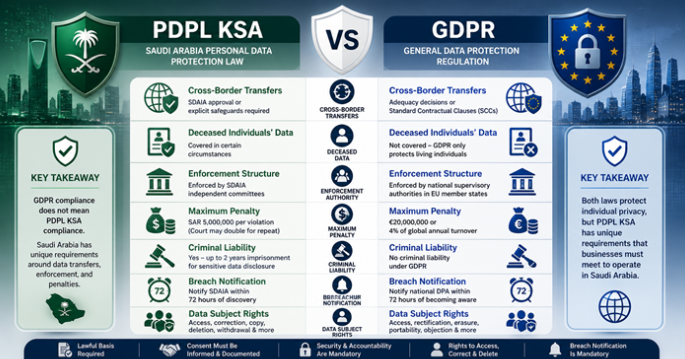
1. Cross-Border Data Transfers
This is the most significant operational difference between the two laws.
| Aspect | PDPL KSA | GDPR |
| Transfer mechanism | SDAIA approval or explicit safeguards required | Adequacy decisions or Standard Contractual Clauses (SCCs) |
| Remote access | Treated as a data export under Article 29 | Not automatically treated as a transfer |
| Recipient country | Must provide adequate protection per SDAIA standards | Must meet EU adequacy criteria |
| Practical impact | International cloud platforms, SaaS tools, overseas support teams all require review | SCCs widely used - more established pathways |
What this means in practice:
Organizations using international cloud platforms (AWS, Azure, Google Cloud), overseas support teams, or global SaaS tools that process Saudi residents' personal data must ensure SDAIA-compliant safeguards are in place - even if those same tools are GDPR compliant.
2. Coverage of Deceased Individuals' Data
| Aspect | PDPL KSA | GDPR |
| Deceased data | Covered in certain circumstances | Not covered - GDPR only protects living individuals |
PDPL KSA extends protections to data of deceased individuals in some cases. GDPR does not address this. Organizations in healthcare and financial services should review how they handle records of deceased clients or patients.
3. Enforcement Structure
| Aspect | PDPL KSA | GDPR |
| Enforcement body | SDAIA - independent Saudi authority | National supervisory authorities (e.g., ICO, CNIL, BfDI) |
| Enforcement committees | Independent multi-disciplinary technical and legal committees | National DPA investigators |
| Investigation process | Electronic platform - strict response timeframes | Varies by national authority |
| Appeal | Does not suspend enforcement | Varies by jurisdiction |
Under PDPL KSA, non-cooperation with SDAIA committees - including missing response deadlines or providing incomplete documentation - is formally recorded and treated as an aggravating factor in enforcement decisions.
4. Penalty Structure
| Aspect | PDPL KSA | GDPR |
| Maximum fine | SAR 5,000,000 (~USD 1.33M) per violation | €20,000,000 or 4% of global annual turnover |
| Repeat violations | Court may double the fine | Percentage-based escalation |
| Criminal liability | Up to 2 years imprisonment for sensitive data disclosure | No criminal liability under GDPR itself |
| Operational impact | Business suspension possible | Suspension of processing activities |
For large global organizations, GDPR fines based on global turnover can be significantly higher. For small and mid-sized businesses operating primarily in Saudi Arabia, PDPL KSA penalties represent a serious financial risk.
5. DPO Requirements
| Aspect | PDPL KSA | GDPR |
| DPO mandatory for | Organizations processing data at large scale or handling sensitive data categories | Public authorities, organizations doing large-scale systematic monitoring, or large-scale sensitive data processing |
| DPO registration | Coordination with SDAIA | Notification to national DPA in some jurisdictions |
The thresholds are broadly similar - but the criteria under PDPL KSA are applied and interpreted by SDAIA, not EU national authorities.
6. Notification Timeframe for Breaches
| Aspect | PDPL KSA | GDPR |
| Authority notification | 72 hours from discovery | 72 hours from becoming aware |
| Individual notification | Required if serious harm is likely | Required without undue delay if high risk to individuals |
The 72-hour clock is the same - but "discovery" under PDPL KSA starts from the moment the breach is identified internally, while GDPR's standard of "becoming aware" has been interpreted with some flexibility by national DPAs. Organizations should treat both as starting immediately on internal discovery.
PDPL KSA vs GDPR - Full Comparison Table
| Aspect | PDPL KSA | GDPR |
| Jurisdiction | Saudi Arabia | European Union |
| In force | September 2024 | May 2018 |
| Enforcement body | SDAIA | National supervisory authorities |
| Max fine | SAR 5,000,000 per violation | €20M or 4% global turnover |
| Criminal liability | Yes - up to 2 years imprisonment | No |
| Cross-border transfers | SDAIA approval or explicit safeguards | Adequacy or SCCs |
| Deceased data | Covered in some cases | Not covered |
| DPO requirement | Large-scale or sensitive data processing | Public bodies + large-scale monitoring/sensitive data |
| Breach notification | 72 hours to SDAIA | 72 hours to national DPA |
| Consent withdrawal | Must be easy - records required | Must be as easy to withdraw as to give |
| Data subject rights | Access, correction, copy, deletion, withdrawal | Access, rectification, erasure, portability, objection |
Why GDPR Compliance Is Not Enough for Saudi Arabia
Organizations that are already GDPR compliant often assume they meet PDPL KSA requirements. This assumption creates compliance gaps in three key areas:
1. Cross-border transfer safeguards GDPR Standard Contractual Clauses (SCCs) do not automatically satisfy PDPL KSA cross-border transfer requirements. SDAIA has its own standards - separate review and documentation is required.
2. Remote access to data Under PDPL Article 29, remote access to personal data stored abroad is treated as a data export. This is not a standard feature of GDPR. Organizations with overseas IT support or global SaaS tools must address this specifically.
3. Local enforcement obligations SDAIA's enforcement committees, response timeframes, and documentation standards are distinct from any EU national DPA. GDPR compliance documentation may not meet SDAIA's requirements in format, content, or language.
What GDPR-Compliant Businesses Need to Do for PDPL KSA
If your organization is already GDPR compliant, the following steps are needed to close the PDPL KSA gap:
- PDPL gap assessment: Review existing policies and controls against PDPL KSA specific requirements
- Cross-border transfer review: Map all data flows leaving Saudi Arabia and document SDAIA-compliant safeguards
- RoPA update: Ensure Records of Processing Activities meet SDAIA documentation standards
- DPO appointment: Assess whether PDPL KSA Article 32 criteria require a DPO or designated compliance contact
- Breach response plan update: Align 72-hour notification procedures with SDAIA requirements specifically
- Staff training: Ensure teams handling Saudi residents' personal data understand PDPL KSA obligations in addition to GDPR
How CyberRT Helps Businesses Navigate PDPL KSA and GDPR
CyberRT provides cybersecurity and compliance services specifically designed for organizations operating in Saudi Arabia. For businesses already working under GDPR, we deliver targeted PDPL KSA gap assessments that focus on the differences - not duplicating work already done.
Our services include:
- PDPL gap assessment: Review of existing GDPR controls against PDPL KSA requirements to identify what additional steps are needed
- Cross-border transfer review: Mapping data flows and implementing SDAIA-compliant safeguards
- DPO-as-a-Service: Qualified data protection officer support for PDPL KSA compliance
- Technical security controls: NCA ECC and SAMA Cyber Framework aligned safeguards required under PDPL Article 19
- Staff awareness training: PDPL-specific training for teams handling Saudi residents' personal data
Frequently Asked Questions
Q1: Is GDPR compliance enough for Saudi Arabia?
No. GDPR compliance does not satisfy PDPL KSA requirements. Key differences - including cross-border transfer rules, deceased data coverage, and SDAIA-specific enforcement obligations - require a separate PDPL gap assessment even if your organization is already GDPR compliant.
Q2: What is the biggest difference between PDPL KSA and GDPR?
The most significant operational difference is cross-border data transfers. PDPL KSA requires SDAIA approval or explicit safeguards for any personal data leaving Saudi Arabia - including remote access to data stored abroad. GDPR's Standard Contractual Clauses do not automatically satisfy this requirement.
Q3: Does PDPL KSA apply to EU companies?
Yes. PDPL KSA applies to any organization processing personal data of individuals residing in Saudi Arabia - regardless of where the organization is based. EU companies serving Saudi customers through websites, apps, or cloud services must comply with PDPL KSA.
Q4: Are PDPL KSA fines higher than GDPR fines?
For large global organizations, GDPR fines based on 4% of global turnover can be significantly higher. For small and mid-sized businesses, PDPL KSA's SAR 5,000,000 maximum - plus criminal liability for sensitive data disclosure - represents a serious risk. PDPL KSA also allows business suspension, which GDPR does not.
Q5: What rights do individuals have under PDPL KSA vs GDPR?
Both laws grant rights to access, correct, and request deletion of personal data. PDPL KSA additionally includes the right to obtain data in a readable format and the right to withdraw consent at any time. GDPR includes data portability as a separate right. The practical scope is broadly similar.