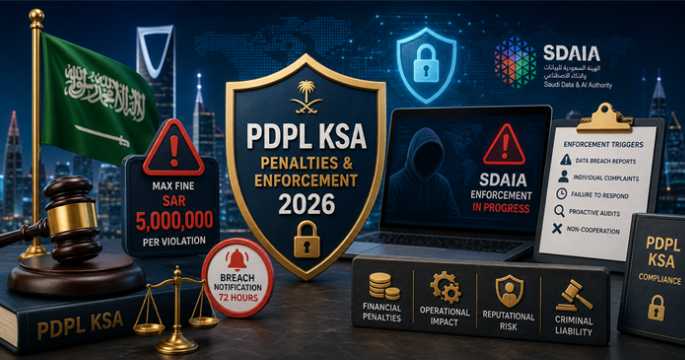
PDPL KSA enforcement is no longer theoretical. Since September 2024, SDAIA has moved from awareness campaigns into active enforcement - moving into visible enforcement activity on non-compliant businesses.
Public reporting in early 2026 indicated that PDPL committees had issued 48 decisions confirming violations. If your organization processes personal data of individuals residing in Saudi Arabia, understanding PDPL KSA penalties and how enforcement works is now a legal obligation - not an option.
What this article covers:
- PDPL KSA penalty structure - fines, criminal liability, operational impact
- How SDAIA enforcement works in 2026
- What triggers an enforcement action
- Which industries face highest scrutiny
- Steps to reduce your enforcement risk
PDPL KSA Penalty Structure
Non-compliance with PDPL KSA carries consequences across four dimensions - financial, criminal, operational, and reputational.
| Penalty Type | Detail |
| Maximum financial fine | SAR 5,000,000 per violation |
| Repeat violations | Court may double the fine - up to SAR 10,000,000 |
| Sensitive data disclosure | Up to 2 years imprisonment and/or SAR 3,000,000 fine |
| Operational impact | Suspension of data processing activities |
| Business impact | Full business suspension in severe cases |
| Reputational impact | Formal enforcement record - visible to investors and partners |
| IPO / M&A risk | Non-compliance creates legal exposure affecting business valuation |
Important: Each violation is assessed separately. An organization with multiple compliance failures - missing consent documentation, no DPO appointment, and an unreported breach - could face multiple penalties simultaneously.
SDAIA Enforcement in 2026 - What Has Changed
2026 marks a clear shift. SDAIA is no longer issuing warnings - it is issuing formal decisions.
How SDAIA enforcement committees work:
- Independent multi-disciplinary committees combine technical and legal expertise
- Committees can summon organizations and request any documentation
- External technical experts can be appointed for complex investigations
- All proceedings are managed through an electronic platform
- Failure to respond within prescribed timeframes is formally recorded and worsens your position
- Committee decisions can be appealed - but appeal does not suspend enforcement
What SDAIA is evaluating in 2026:
SDAIA has shifted from reviewing policies on paper to assessing operational readiness. Organizations are expected to demonstrate:
- How personal data flows through their systems
- Who has access and why
- How long data is retained and what controls govern deletion
- Whether consent was properly obtained and documented
- Whether breach response procedures exist and have been tested
Having a privacy policy on a website is not sufficient. SDAIA expects operational proof.
What Triggers a PDPL KSA Enforcement Action

Enforcement actions are initiated through five main channels:
1. Data Breach Reports
- Organizations must notify SDAIA within 72 hours of discovering a breach
- When a breach notification is filed, SDAIA automatically reviews whether adequate security controls were in place
- A breach is both a notification obligation and an enforcement trigger
2. Individual Complaints
- Any Saudi resident whose data rights have been violated can file a complaint directly with SDAIA
- Common triggers include failure to respond to data access requests, unauthorized marketing use of personal data, and failure to honor deletion requests
3. Failure to Respond to Data Subject Requests
- PDPL grants individuals rights to access, correct, and delete their personal data
- Organizations have defined timeframes to respond
- Failure to respond - or providing inadequate responses - is a direct enforcement trigger
4. Proactive Sector Audits
- SDAIA conducts proactive audits based on sector risk profiles
- Healthcare, financial services, and ecommerce organizations processing large volumes of sensitive data face higher audit frequency
5. Non-Cooperation with Previous Investigations
- Failure to provide documentation, missing response deadlines, or providing incomplete information escalates enforcement action
- Non-cooperation is formally recorded and treated as an aggravating factor
Industries Under Highest Enforcement Scrutiny
| Industry | Primary Risk | Enforcement Focus |
| Healthcare | Patient records, medical data | Consent, security controls, cross-border transfers |
| Financial Services | Customer financial and identity data | SAMA alignment, breach notification, data retention |
| Ecommerce and Retail | Customer accounts, payment data | Consent management, marketing data use |
| Technology and SaaS | User data, behavioral analytics | Cross-border transfers, DPO appointment, RoPA |
| Logistics and Supply Chain | Employee and customer data | Vendor contracts, data minimization |
| HR and Recruitment | Employee sensitive data | Legal basis, retention periods, data subject rights |
Most Common PDPL Violations in 2026
Based on SDAIA's published enforcement activity, these are the violations most frequently cited in formal decisions:
1. Processing personal data without a valid legal basis
- Collecting or using personal data without proper consent or another lawful basis under Article 6
- Most common violation category in 2026 enforcement decisions
2. Inadequate technical security controls
- PDPL Article 19 requires security measures aligned with data sensitivity
- Organizations that cannot demonstrate NCA ECC-aligned controls are highly vulnerable
3. Unauthorized disclosure of personal data
- Sharing data with third parties without proper data processing agreements
- Includes sharing with vendors, partners, and overseas service providers without safeguards
4. Failure to notify SDAIA within 72 hours of a breach
- The 72-hour clock starts from the moment of discovery - not confirmation
- Delayed notification is one of the most straightforward enforcement triggers
5. Failure to honor data subject requests
- Not responding to access, correction, or deletion requests within required timeframes
- Both a direct violation and a complaint trigger
PDPL KSA vs GDPR - Penalty Comparison
| Aspect | PDPL KSA | GDPR |
| Maximum fine | SAR 5,000,000 (~USD 1.33M) | €20M or 4% of global turnover |
| Criminal liability | Up to 2 years imprisonment | No criminal liability |
| Repeat violation | Court can double the fine | Percentage-based escalation |
| Enforcement body | SDAIA committees | National supervisory authorities |
| Cross-border transfers | Stricter - SDAIA approval required | Adequacy decisions or SCCs |
GDPR compliance does not substitute for PDPL KSA compliance. A separate PDPL gap assessment is required even if your organization is already GDPR compliant.
How to Reduce Your PDPL KSA Enforcement Risk
1. Complete a PDPL Gap Assessment
- Formally review data handling practices, security controls, vendor relationships, and documentation
- Identifies compliance gaps before SDAIA does
- Provides a clear roadmap for remediation
2. Appoint a Data Protection Officer (DPO)
- Mandatory for organizations processing personal data at large scale or handling sensitive data categories
- Provides a direct point of contact for SDAIA
- Manages compliance oversight and data subject request handling
3. Implement a Breach Response Plan
- Document detection, containment, assessment, and 72-hour SDAIA notification procedures
- Organizations that notify SDAIA promptly are treated more favorably in enforcement proceedings
- Must be tested before an incident occurs - not created after
4. Align Technical Controls with NCA ECC
- PDPL Article 19 requires technical and organizational security measures
- NCA Essential Cybersecurity Controls (ECC) is the recognized standard for Saudi organizations
- Includes encryption, access controls, monitoring, and data loss prevention
5. Train All Staff Who Handle Personal Data
- Human error is a leading cause of breaches and compliance failures
- PDPL-specific training covers breach recognition, data subject rights, and consent procedures
- Directly reduces both breach risk and enforcement exposure
6. Build and Maintain Records of Processing Activities (RoPA)
- Document all processing activities - what data, why, how long, who it is shared with
- SDAIA can request RoPA documentation during any investigation
- Must be kept updated as processing activities change
How CyberRT Helps Saudi Businesses Reduce PDPL Enforcement Risk
CyberRT provides cybersecurity and compliance services specifically designed for organizations operating in Saudi Arabia. Our PDPL enforcement risk reduction services include:
- PDPL gap assessment: review of data handling practices, security controls, vendor relationships, and documentation against PDPL KSA requirements
- DPO-as-a-Service: qualified data protection officer support without the cost of a full-time hire
- Technical security controls: NCA ECC and SAMA Cyber Framework aligned safeguards required under PDPL Article 19
- Security awareness training: PDPL-specific training to reduce human-driven compliance risks and enforcement exposure
- Breach response planning: documented procedures for detection, containment, and 72-hour SDAIA notification
Frequently Asked Questions
Q1: What is the maximum PDPL KSA fine?
The maximum financial penalty is SAR 5,000,000 per violation. For repeat violations, the court may double this to SAR 10,000,000. Sensitive data disclosure carries additional criminal liability of up to 2 years imprisonment and a separate fine of up to SAR 3,000,000.
Q2: How many PDPL enforcement decisions has SDAIA issued?
As of January 2026, SDAIA has issued 48 formal enforcement decisions. Businesses across healthcare, finance, and ecommerce have received formal notifications, investigations, and indictments. Enforcement is accelerating in 2026.
Q3: What triggers a PDPL KSA investigation?
The main triggers are data breach reports filed with SDAIA, complaints submitted by individuals, failure to respond to data subject requests, proactive sector audits, and non-cooperation with previous SDAIA inquiries.
Q4: Does PDPL KSA apply to foreign companies?
Yes. Any organization processing personal data of Saudi residents - regardless of where it is headquartered - must comply with PDPL KSA. This includes international SaaS platforms, ecommerce sites, and cloud services serving Saudi customers.
Q5: How does CyberRT help with PDPL enforcement risk?
CyberRT provides PDPL gap assessments, DPO-as-a-Service, NCA ECC-aligned technical controls, breach response planning, and PDPL-specific staff awareness training - covering all technical and operational requirements SDAIA evaluates during enforcement actions.