This guide is provided for general informational purposes only and does not constitute legal advice. PDPL obligations may vary based on your role (controller/processor), sector requirements, and your specific processing activities. For formal interpretation or legal decisions, consult qualified counsel and refer to official SDAIA/NDMO regulations and guidance
Introduction
Saudi Arabia is undergoing a rapid digital transformation. From fintech and e-commerce to healthcare, SaaS, and government services, organizations across the Kingdom are collecting and processing more personal data than ever before. As part of Vision 2030 and the push toward a strong digital economy, protecting personal information has become a national priority. This shift has made PDPL compliance a critical requirement for businesses operating in or targeting Saudi Arabia.
The Saudi data protection law establishes a structured legal framework that governs how personal data must be collected, processed, stored, and transferred. It sets clear rules for organizations acting as data controllers and processors and strengthens the rights of individuals over their personal information. Unlike earlier fragmented practices, this law creates a unified compliance obligation that businesses can no longer overlook.
Growing Regulatory Pressure in the Kingdom
Regulatory enforcement in Saudi Arabia is becoming more structured and proactive. Authorities are increasing oversight of data processing activities, especially in high-risk sectors such as financial services, healthcare, cybersecurity, and cloud services. Businesses are expected to demonstrate accountability, maintain documentation, and implement appropriate technical and organizational safeguards.
Organizations can no longer rely on informal privacy practices. Clear consent mechanisms, lawful processing bases, data minimization, and breach notification protocols are now part of the legal landscape. Regulatory scrutiny is not limited to large enterprises. SMEs, startups, and even foreign entities processing Saudi residents’ data fall within scope.
As enforcement mechanisms mature, non-compliant organizations face higher operational and reputational risks. Regulatory investigations, audits, and complaints from data subjects are becoming more common. This makes early adoption of compliance measures a strategic necessity rather than a reactive step.
Who Must Comply with the Law
The scope of the Saudi data protection framework is broad. It applies to:
- Companies established in Saudi Arabia that process personal data
- Foreign businesses offering goods or services to Saudi residents
- Government and semi-government entities handling personal data
- Digital platforms, SaaS providers, and e-commerce operators
- Employers processing employee and HR data
Whether an organization processes customer data, employee records, website analytics, or marketing databases, it is likely subject to the law. Even businesses that outsource data processing remain responsible for ensuring their vendors and service providers meet regulatory standards.
What Happens If Businesses Ignore PDPL
Ignoring regulatory obligations exposes businesses to significant consequences. Financial penalties are only one aspect of the risk. Organizations may also face operational disruptions, suspension of data processing activities, or criminal liability in severe cases involving sensitive data misuse.
Beyond legal penalties, reputational damage can be far more costly. In today’s digital economy, customer trust is directly tied to data protection. A publicized breach or compliance failure can erode brand credibility, reduce customer retention, and impact long-term growth.
Investors and partners are also increasingly evaluating privacy governance frameworks before entering into agreements. Weak compliance controls can delay contracts, limit cross-border operations, and create barriers to expansion.
Why Acting Now Is Essential
The digital ecosystem in Saudi Arabia is expanding rapidly, and regulatory enforcement is evolving alongside it. Businesses that prioritize compliance early can turn regulatory adherence into a competitive advantage. Strong privacy governance builds customer trust, strengthens cybersecurity posture, and improves internal data management practices.
In this environment, PDPL compliance is not merely a legal checkbox. It is a foundational component of responsible digital growth in Saudi Arabia. Organizations that understand the requirements and implement structured compliance frameworks position themselves for sustainable success in the Kingdom’s regulated digital economy.
What Is PDPL? (Overview of Saudi Data Protection Law)
Understanding PDPL compliance begins with a clear understanding of the law itself. The Personal Data Protection Law is Saudi Arabia’s primary legal framework governing how personal data is collected, processed, stored, and transferred. It establishes structured obligations for organizations and strengthens the rights of individuals whose data is being processed.
As Saudi Arabia accelerates its digital transformation, this law provides the legal backbone for privacy, accountability, and responsible data governance across all sectors.
Definition of PDPL
The Personal Data Protection Law, commonly referred to as PDPL, is Saudi Arabia’s comprehensive data protection regulation. It sets out the rules that organizations must follow when handling personal information related to individuals within the Kingdom.
The law outlines:
- Conditions for lawful data collection
- Requirements for processing and storage
- Data subject rights
- Cross-border transfer restrictions
- Breach notification obligations
- Penalties for violations
In simple terms, PDPL defines how businesses must manage personal data in a transparent, secure, and legally compliant manner.
Who Introduced It and Why
The law was issued by the Saudi government as part of its broader effort to modernize the Kingdom’s regulatory framework and support Vision 2030 initiatives. As digital services expanded across sectors such as fintech, healthcare, e-commerce, and cloud computing, the need for a unified data protection system became essential.
The introduction of PDPL was driven by several strategic objectives:
- Strengthening individual privacy rights
- Building trust in digital services
- Attracting foreign investment
- Aligning with global data protection standards
- Supporting secure cross-border trade
By establishing clear legal obligations, Saudi Arabia aims to create a secure digital ecosystem that balances innovation with privacy protection.
When It Came Into Effect
The Saudi Personal Data Protection Law (PDPL) came into force on 14 September 2023. Organizations were granted a one-year compliance grace period, and the law became fully enforceable from 14 September 2024. Implementing Regulations and related guidance provide the detailed operational requirements businesses must follow.
Scope of the Law
The scope of the Saudi data protection law is broad and applies to nearly all forms of personal data processing activities.
It covers:
- Collection of personal data
- Recording and storage
- Analysis and profiling
- Sharing with third parties
- Cross-border transfers
- Deletion and retention practices
The law applies regardless of whether processing is done electronically or manually, as long as personal data is involved.
Importantly, the regulation applies to both private and public entities. It is not limited to a specific industry. Any organization handling personal data within Saudi Arabia falls within its scope.
Applicability Inside and Outside Saudi Arabia
One of the most important aspects of PDPL compliance is its territorial reach.
The law applies to:
- Organizations located within Saudi Arabia that process personal data
- Foreign companies processing personal data of individuals residing in Saudi Arabia
This extraterritorial application means international SaaS providers, cloud platforms, e-commerce websites, and digital service providers must assess their exposure if they collect or process data related to Saudi residents.
Even if a company has no physical presence in the Kingdom, it may still be required to comply if it targets or serves Saudi individuals.
Purpose of the Law
The core purpose of the Personal Data Protection Law is to protect individual privacy while enabling secure economic growth.
Its objectives include:
- Safeguarding personal information from misuse
- Ensuring transparency in data handling practices
- Preventing unauthorized disclosure
- Establishing accountability for organizations
- Enhancing cybersecurity and risk management standards
By setting clear rules for lawful processing, the law promotes responsible innovation without compromising individual rights.
Who Is Considered a Data Controller or Processor
Understanding these roles is critical for PDPL compliance.
Data Controller
A data controller is any entity that determines:
- Why personal data is collected
- What type of data is collected
- How it will be processed
- How long it will be retained
In most business contexts, the company itself acts as the data controller. For example:
- An e-commerce website collecting customer information
- A hospital managing patient records
- An employer processing employee data
The controller holds primary responsibility for compliance.
Data Processor
A data processor is an entity that processes personal data on behalf of the controller.
Examples include:
- Cloud storage providers
- Payroll processing companies
- IT service providers
- Marketing automation platforms
Processors must follow contractual instructions from the controller and implement adequate security measures. However, the ultimate accountability often remains with the controller.
What Qualifies as Personal Data
Personal data under the Saudi data protection law includes any information that can identify an individual directly or indirectly.
Examples include:
- Full name
- National ID number
- Passport details
- Contact information
- Email addresses
- Phone numbers
- IP addresses
- Financial information
- Biometric data
- Health records
The definition also includes sensitive personal data, such as:
- Health data
- Genetic data
- Biometric identifiers
- Religious or belief-related information
Sensitive data typically requires stricter processing controls and stronger safeguards.
Even data that does not immediately identify someone but can be combined with other information to identify them may fall under the law’s scope.
Why This Overview Matters for PDPL Compliance
Before implementing policies or technical safeguards, organizations must understand the structure, scope, and definitions within the law. Misinterpreting the roles of controllers and processors or underestimating what qualifies as personal data can lead to serious compliance gaps.
A strong foundation begins with a clear understanding of what the Saudi data protection law requires and who it applies to. Once these fundamentals are clear, businesses can move confidently toward implementing structured PDPL compliance frameworks.
Who Needs PDPL Compliance?
One of the most common misconceptions about PDPL compliance is that it only applies to large corporations or government institutions. In reality, the scope of the Saudi data protection law is intentionally broad. Any organization that collects, processes, stores, or transfers personal data related to individuals in Saudi Arabia must assess its compliance obligations.
Below is a detailed breakdown of who falls under the law.
Saudi-Based Companies
Any company established and operating within Saudi Arabia is subject to PDPL if it processes personal data.
This includes businesses that handle:
- Customer information
- Employee records
- Vendor or supplier data
- Website visitor data
- Marketing databases
Whether the organization operates physically, digitally, or both, processing personal data creates compliance responsibility.
Examples:
- A retail chain collecting customer contact details
- A logistics company storing delivery recipient information
- A private hospital managing patient files
- A local marketing agency running email campaigns
If personal data is involved, PDPL compliance is required.
Foreign Companies Handling Saudi Residents’ Data
The Saudi data protection law has extraterritorial reach. This means organizations located outside Saudi Arabia can still be required to comply if they process personal data of individuals residing in the Kingdom.
Foreign companies must assess compliance if they:
- Offer goods or services to Saudi residents
- Operate Arabic-language platforms targeting the Saudi market
- Collect payment information from customers in Saudi Arabia
- Use behavioral tracking or analytics on Saudi users
Examples:
- An international SaaS provider with Saudi clients
- A global e-commerce platform shipping products to Riyadh
- A foreign cloud provider hosting data for Saudi companies
- A fintech startup processing transactions for Saudi customers
Physical presence is not required for the law to apply. Processing Saudi residents’ data is enough to trigger obligations.
Government and Semi-Government Entities
Public authorities are also subject to the Saudi data protection framework. Ministries, municipalities, public hospitals, universities, and regulatory bodies must comply when handling personal data.
Government entities often process large volumes of:
- National identification data
- Health records
- Tax information
- Employment records
- Licensing data
Due to the sensitive nature of this data, compliance standards are often stricter, and accountability mechanisms must be well documented.
SMEs, Startups, and Large Enterprises
PDPL compliance is not limited by company size. Small and medium-sized enterprises, startups, and multinational corporations all fall under the same legal framework if they process personal data.
A startup collecting customer emails for marketing must comply just as a large enterprise handling millions of records must comply.
For SMEs and startups, common processing activities include:
- Online payment processing
- CRM systems storing customer profiles
- HR systems managing employee data
- Digital advertising and analytics tracking
Although implementation strategies may differ based on scale, the legal obligation remains the same.
E-Commerce and SaaS Businesses
Digital-first businesses are particularly exposed under the Saudi data protection law because their core operations rely heavily on personal data.
E-commerce platforms process:
- Names and addresses
- Payment details
- Order history
- Device and IP data
SaaS providers process:
- User account information
- Business data
- Usage analytics
- Support tickets
Since these models involve continuous data processing, structured PDPL compliance frameworks are essential. Consent management, secure storage, cross-border transfer controls, and breach notification procedures must be clearly defined.
Practical Industry Examples
To better understand the scope, here are sector-specific examples where compliance becomes critical.
Healthcare Sector
Healthcare organizations process highly sensitive personal data, including:
- Medical records
- Diagnostic reports
- Biometric identifiers
- Insurance information
Hospitals, clinics, telemedicine platforms, and health-tech startups must implement strict access controls, encryption measures, and clear consent procedures.
A breach in this sector not only risks legal penalties but also severe reputational damage.
Fintech and Financial Services
Banks, payment gateways, digital wallets, and investment platforms handle:
- Financial account details
- Transaction histories
- Credit information
- Identity verification data
Because financial data is high-risk, compliance requirements often overlap with cybersecurity and anti-money laundering frameworks. Data protection measures must be tightly integrated with financial security controls.
HR and Payroll Services
Organizations process employee data such as:
- Salary information
- National ID numbers
- Bank details
- Performance records
- Health and insurance data
Companies using outsourced payroll providers remain responsible for ensuring that processors meet regulatory standards. Employment contracts and internal policies must align with PDPL requirements.
Cybersecurity Firms
Cybersecurity companies often process:
- Incident logs
- Network activity data
- Client infrastructure information
- Threat intelligence data
While protecting clients from cyber threats, these firms must also ensure their own data handling practices comply with the law. Monitoring tools and logging systems must operate within lawful processing boundaries.
Core PDPL Requirements Explained
To achieve effective PDPL compliance, organizations must understand and implement the core legal obligations defined under the Saudi data protection law. These requirements form the operational backbone of any compliance framework. Ignoring even one of these areas can expose a business to regulatory risk.
Below is a detailed breakdown of the most critical PDPL requirements every organization must address.
Lawful Basis for Processing
Under the Saudi data protection law, personal data cannot be collected or processed arbitrarily. Every processing activity must have a lawful basis.
Organizations must clearly define:
- Why the data is being collected
- How it will be used
- What legal ground justifies the processing
Common lawful bases include:
Consent
The data subject provides clear, explicit permission for their data to be processed. Consent must be:
- Freely given
- Specific
- Informed
- Documented
Pre-ticked boxes or vague notices do not meet compliance standards.
Contractual Necessity
Processing is required to fulfill a contract with the individual.
Example: Processing delivery details for an online order.
Legal Obligation
Processing is necessary to comply with a legal requirement under Saudi law.
Example: Maintaining payroll records for regulatory reporting.
Legitimate Interests
In limited circumstances, processing may be allowed if it serves a legitimate business purpose and does not override individual rights.
Organizations must document their chosen legal basis for each processing activity. Lack of documentation is a common compliance gap.
Data Subject Rights
A central objective of PDPL compliance is empowering individuals with control over their personal information. The law grants data subjects several enforceable rights.
Right to Access
Individuals have the right to:
- Request confirmation that their data is being processed
- Obtain a copy of their personal data
- Understand how and why it is being used
Organizations must establish clear procedures to respond to access requests within defined timeframes.
Right to Correction
If personal data is inaccurate, incomplete, or outdated, individuals can request correction.
Businesses must:
- Verify the accuracy of stored data
- Update records promptly
- Notify third parties if the incorrect data was shared
Failure to maintain accurate data may lead to compliance violations.
Right to Deletion
Also known as the right to erasure, this allows individuals to request deletion of their personal data when:
- It is no longer necessary
- Consent has been withdrawn
- Processing is unlawful
However, deletion may be denied if the data is required for legal or regulatory purposes. Organizations must clearly define retention justifications.
Right to Withdraw Consent
If processing is based on consent, individuals can withdraw it at any time.
Organizations must:
- Make withdrawal as easy as giving consent
- Stop processing unless another lawful basis applies
- Update internal records accordingly
Consent management systems are critical for meeting this requirement.
Data Minimization Principle
One of the most important PDPL requirements is collecting only the data that is strictly necessary.
Organizations must ensure:
- No excessive or irrelevant data is collected
- Data fields are aligned with business purpose
- Collection forms are limited to essential information
For example, an e-commerce checkout page should not request unnecessary personal details unrelated to the transaction.
Data minimization reduces risk exposure and strengthens overall compliance posture.
Data Retention and Storage
Personal data cannot be stored indefinitely. The Saudi data protection law requires organizations to:
- Define clear retention periods
- Justify how long data is kept
- Securely delete data once no longer needed
Retention policies must be documented and applied consistently across systems.
Additionally, storage must meet security standards, including:
- Encryption
- Access controls
- Role-based permissions
- Secure backup mechanisms
Improper retention practices are one of the most frequent audit findings in data protection reviews.
Cross-Border Data Transfers
Transferring personal data outside Saudi Arabia is subject to strict controls.
Organizations must ensure:
- The transfer complies with the Transfer Regulation and PDPL conditions (including purpose/necessity and required safeguards).
- Appropriate safeguards are implemented (e.g., Standard Contractual Clauses, Binding Common Rules, or approved certification/safeguard mechanisms where applicable).
- A documented transfer assessment is performed and retained (data categories, recipient, destination, safeguards, risks, and mitigations).
This requirement is especially relevant for:
- Cloud service providers
- International SaaS platforms
- Multinational organizations
- Outsourced data processors
Uncontrolled cross-border transfers can result in severe regulatory consequences. Businesses must conduct transfer assessments before exporting data.
Data Breach Notification Requirements
PDPL compliance includes mandatory procedures for handling data breaches.
A data breach may involve:
- Unauthorized access
- Data leaks
- Accidental disclosure
- Cyberattacks
- Loss of storage devices
When a breach occurs, organizations must:
- Contain and assess the incident (scope, impact, affected data, likely harm).
- Notify the competent authority within 72 hours of becoming aware of the breach if it may cause harm to personal data, the data subject, or their rights/interests.
- Notify affected individuals without undue delay when the breach is likely to cause harm or presents high risk to their rights/interests.
- Document the breach, decisions taken (including if you decided not to notify), and remediation steps in a breach register.
- Follow SDAIA’s breach handling guidance for investigation, evidence, remediation, and communications.
An internal incident response plan is essential. Delayed reporting or poor documentation can increase penalties.
Appointing a Data Protection Officer
Organizations must appoint a Data Protection Officer (DPO) where the law’s criteria apply.
A Data Protection Officer is responsible for:
- Monitoring compliance efforts
- Advising management on regulatory obligations
- Conducting internal audits
- Serving as a point of contact with regulators
- Overseeing risk assessments
- The DPO should have appropriate data protection expertise, sufficient authority/resources, and independence (avoid conflicts of interest).
- The DPO can be internal or outsourced, but must be able to perform the role effectively
Even when not legally mandatory, appointing a compliance lead strengthens governance and demonstrates accountability.
For large enterprises, fintech companies, healthcare providers, and organizations processing sensitive data, this role becomes strategically important.
Step by Step PDPL Compliance Framework
Understanding the Saudi data protection law is only the first step. Real PDPL compliance requires structured implementation. Below is a practical, actionable framework that organizations can follow to move from awareness to full operational compliance.
This section turns legal obligations into measurable actions.
Step 1: Conduct Data Mapping
Before implementing controls, organizations must understand what data they actually process.
Data mapping is the foundation of compliance. It involves identifying:
- What personal data is collected
- Where it is stored
- Why it is processed
- Who has access to it
- With whom it is shared
- How long it is retained
Key Actions
- Create a data inventory register
- Identify all data sources such as websites, CRM systems, HR systems, marketing tools, and cloud platforms
- Classify data into categories such as personal data and sensitive personal data
- Document data flows, including internal transfers and third party processors
Without accurate data mapping, compliance efforts are incomplete. Many organizations discover unknown data repositories during this stage, which often represent hidden risk.
Step 2: Perform Gap Analysis
Once data mapping is complete, the next step is to compare current practices against PDPL requirements.
Gap analysis identifies weaknesses in:
- Consent mechanisms
- Data retention policies
- Security controls
- Cross-border transfers
- Data subject rights procedures
Key Questions to Ask
- Do we have documented lawful bases for all processing activities?
- Are privacy notices clear and transparent?
- Can we respond to access and deletion requests efficiently?
- Are vendor agreements aligned with the Saudi data protection law?
The outcome of this step should be a prioritized remediation plan. High-risk gaps, especially those involving sensitive data or cross-border transfers, should be addressed first.
Step 3: Update Privacy Policies
Transparency is a core principle of PDPL compliance. Organizations must clearly communicate how personal data is handled.
Privacy notices should include:
- Types of personal data collected
- Purpose of processing
- Legal basis for processing
- Retention periods
- Data subject rights
- Contact details for inquiries
Policies should be:
- Easy to understand
- Accessible on websites and applications
- Available in appropriate languages for the target audience
Internal policies must also be updated, including:
- Data retention policies
- Information security policies
- Vendor management procedures
- Employee data handling guidelines
Policy updates are not just legal formalities. They must reflect actual operational practices.
Step 4: Implement Technical Safeguards
Legal compliance must be supported by technical protection measures.
Organizations should implement:
- Encryption for stored and transmitted data
- Role-based access controls
- Multi-factor authentication
- Secure backup systems
- Network monitoring and intrusion detection
- Data loss prevention tools
Access should be limited strictly to personnel who require it for legitimate business purposes.
For sensitive personal data, enhanced security controls may be required, including additional monitoring and restricted access environments.
Cybersecurity integration is critical. Weak technical controls can undermine otherwise strong compliance documentation.
Step 5: Train Employees
Even the strongest compliance framework can fail if employees are unaware of their responsibilities.
Training should cover:
- Basic principles of the Saudi data protection law
- Proper handling of personal data
- Recognizing phishing and social engineering attempts
- Secure data sharing practices
- Procedures for reporting incidents
Training should not be a one-time activity. Regular refreshers and updates are necessary, especially when regulatory guidance evolves.
Different departments require tailored training:
- HR teams handle employee data
- Marketing teams manage customer databases
- IT teams manage system security
- Customer service teams respond to access requests
Human error is one of the leading causes of data breaches. Education significantly reduces this risk.
Step 6: Establish Breach Response Plan
No organization is immune to cyber incidents. PDPL compliance requires having a structured incident response plan in place before a breach occurs.
A breach response framework should include:
- Defined internal reporting channels
- Incident classification criteria
- Investigation procedures
- Communication protocols
- Regulatory notification timelines
- Documentation requirements
Roles and responsibilities must be clearly assigned. Employees should know exactly whom to notify if suspicious activity is detected.
A well-prepared response can reduce regulatory penalties and reputational damage. Delayed or disorganized responses often increase enforcement severity.
Step 7: Maintain Documentation
Accountability is a central theme of the Saudi data protection law. Organizations must be able to demonstrate compliance, not just claim it.
Essential documentation includes:
- Data processing records
- Lawful basis justifications
- Risk assessments
- Vendor agreements
- Cross-border transfer assessments
- Incident logs
- Training records
- Audit reports
Regulators may request evidence during inspections or investigations. Proper documentation proves that compliance efforts are active and structured.
Ongoing monitoring is also necessary. Compliance is not a one-time project. As business operations evolve, new processing activities must be assessed and documented.
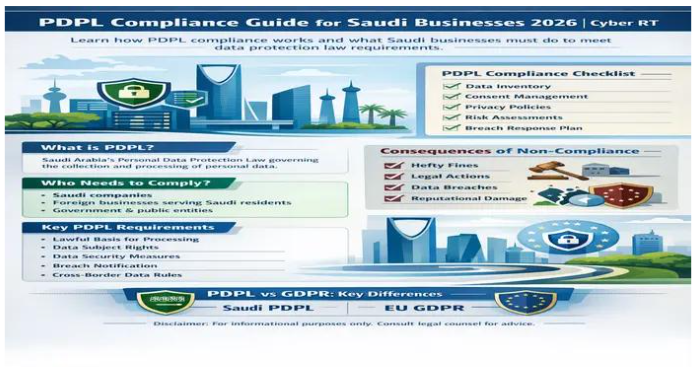
The Ultimate PDPL Checklist for Businesses

For organizations aiming to achieve structured PDPL compliance, having a practical and scannable PDPL checklist is essential. While policies and frameworks are important, compliance ultimately depends on whether specific operational controls are in place and functioning.
Below is a comprehensive checklist that businesses in Saudi Arabia can use to assess their readiness under the Saudi data protection law.
Use this checklist to evaluate whether your organization meets core regulatory requirements.
Data Inventory Completed
- All personal data processing activities are identified
- Data types are classified, including sensitive personal data
- Data flow diagrams document internal and external transfers
- Storage locations are clearly mapped, including cloud systems
- Retention periods are defined for each data category
Why it matters:
Without a complete data inventory, organizations cannot control or protect what they do not fully understand. Data mapping is the foundation of effective PDPL compliance.
Legal Basis Documented
- Every processing activity has a documented lawful basis
- Consent is recorded where required
- Contractual and legal justifications are clearly defined
- Legitimate interest assessments are performed where applicable
Why it matters:
The Saudi data protection law requires organizations to justify why personal data is processed. Undocumented processing creates significant regulatory risk.
Consent Mechanism Implemented
- Clear and transparent consent notices are displayed
- Consent is specific and not bundled with unrelated terms
- Users can withdraw consent easily
- Consent records are securely stored and auditable
Why it matters:
Invalid or poorly designed consent mechanisms are one of the most common compliance failures. Consent must be demonstrable and traceable.
Privacy Notice Updated
- Privacy policy clearly explains data collection practices
- Processing purposes are described in plain language
- Data subject rights are explained
- Cross-border transfer information is disclosed
- Contact information for privacy inquiries is provided
Why it matters:
Transparency is a core principle of PDPL compliance. Privacy notices must reflect actual business practices and remain up to date.
Data Processing Agreements Signed
- Contracts with third party processors include data protection clauses
- Vendors commit to appropriate security standards
- Roles and responsibilities are clearly defined
- Cross-border safeguards are contractually addressed
Why it matters:
Outsourcing data processing does not remove accountability. Controllers remain responsible for ensuring processors comply with the Saudi data protection law.
Cross-Border Transfer Controls in Place
- International data transfers are assessed and documented
- Adequate safeguards are implemented
- Regulatory conditions for export are satisfied
- Transfer impact assessments are conducted when required
Why it matters:
Improper international data transfers can trigger severe penalties. Businesses using global cloud services must pay special attention to this area.
Incident Response Policy Created
- Maintain an inventory/register of cross-border transfers (systems, vendors, countries, data types).
- Perform and store a transfer assessment (risk + safeguards) before enabling transfers.
- Use approved safeguards (e.g., SCCs/BCRs/certification) in vendor contracts.
- Ensure sub-processors are controlled (flow-down obligations + audit/assurance).
- Reassess transfers on material change (new country/vendor/system or incident).
Why it matters:
When a breach occurs, response speed and documentation determine regulatory outcomes. A structured incident plan is mandatory for strong PDPL compliance.
Internal Audits Scheduled
- Periodic compliance reviews are planned
- High-risk processing activities are reassessed regularly
- Vendor compliance is reviewed
- Policy updates are tracked and documented
- Training effectiveness is evaluated
Why it matters:
Compliance is not a one-time exercise. Regular audits ensure ongoing alignment with regulatory expectations.
PDPL vs GDPR: Key Differences

As Saudi Arabia strengthens its privacy framework, many organizations assume that being compliant with the GDPR automatically ensures PDPL compliance. While there are similarities between the Saudi data protection law and the European General Data Protection Regulation, important differences exist.
Understanding these distinctions is critical for multinational companies and Saudi businesses working with international partners.
Consent Requirements
Both frameworks emphasize lawful processing, but consent under PDPL and GDPR is not identical in application.
Under GDPR
Consent must be:
- Freely given
- Specific
- Informed
- Unambiguous
- Demonstrated through a clear affirmative action
GDPR also heavily regulates special categories of data and imposes strict documentation standards.
Under PDPL
Consent is a central lawful basis but is often interpreted more strictly in practice. Organizations must:
- Obtain explicit consent before collecting personal data unless another lawful basis applies
- Clearly explain processing purposes
- Allow easy withdrawal of consent
- Maintain documented proof
One notable difference is that PDPL places stronger emphasis on prior consent in many scenarios, particularly where no clear contractual or legal basis exists.
Key takeaway:
If a company relies heavily on legitimate interest under GDPR, it must carefully reassess whether that basis is acceptable under the Saudi data protection law.
Cross-Border Transfers and Data Residency Expectations
Data localization is one of the most important structural differences.
Under GDPR
The GDPR does not require personal data to remain within the European Union. Data can be transferred outside the EU if adequate safeguards are in place.
Under PDPL
The Saudi framework initially imposed stricter controls on transferring personal data outside the Kingdom. While regulations have evolved, cross-border transfers remain tightly regulated.
Organizations must ensure:
- Specific conditions are satisfied
- Regulatory approvals may be required in certain cases
- Adequate protection standards exist in the receiving jurisdiction
Key takeaway:
Businesses using international cloud infrastructure must evaluate whether their hosting arrangements comply with PDPL requirements, even if they already meet GDPR standards.
Penalties
Both laws impose financial penalties, but their enforcement structures differ.
GDPR Penalties
GDPR fines can reach:
- Up to 20 million euros, or
- 4 percent of global annual turnover, whichever is higher
Penalties are tiered depending on the severity of the violation.
PDPL Penalties
Under the Saudi data protection law, penalties may include:
- Financial fines
- Potential criminal liability in serious cases
- Confiscation of illegally obtained data
- Public disclosure of violations
While maximum fines may differ in structure compared to GDPR, enforcement authority in Saudi Arabia includes broader legal consequences beyond administrative fines.
Key takeaway:
Non-compliance under PDPL may carry reputational and legal consequences beyond monetary penalties.
Supervisory Authority
The regulatory structure overseeing compliance differs significantly.
Under GDPR
Each EU member state has an independent supervisory authority.
The European Data Protection Board coordinates cross-border matters.
This creates a multi-layered regulatory system across the European Union.
Under PDPL
Compliance is overseen by designated Saudi authorities responsible for data protection governance. Oversight is centralized within the Kingdom’s regulatory framework.
This centralized structure can result in more unified enforcement approaches compared to the decentralized EU system.
Key takeaway:
Organizations operating in Saudi Arabia must understand local regulatory expectations rather than relying solely on EU regulatory interpretations.
Cross-Border Rules
Cross-border data transfer rules exist in both frameworks but operate differently.
GDPR Approach
Transfers outside the EU are permitted when:
- The receiving country has an adequacy decision
- Standard contractual clauses are used
- Binding corporate rules are approved
- Derogations apply
PDPL Approach
Cross-border transfers are allowed only when specific regulatory conditions are satisfied. These may include:
- Ensuring the receiving jurisdiction provides adequate protection
- Obtaining regulatory approval in certain scenarios
- Demonstrating necessity for the transfer
- Ensuring safeguards for sensitive personal data
In some situations, PDPL requirements may be more restrictive than GDPR.
Key takeaway:
Companies cannot assume GDPR-compliant transfer mechanisms automatically satisfy Saudi data protection law.
Penalties and Consequences of Non-Compliance
Failing to implement proper PDPL compliance is not just a regulatory oversight. It can expose businesses to financial loss, legal liability, reputational harm, and operational disruption. The Saudi data protection law establishes enforcement mechanisms designed to ensure organizations take privacy obligations seriously.
Below is a detailed breakdown of the consequences organizations may face if they fail to comply.
Financial Penalties
One of the most immediate risks of non-compliance is monetary fines. The Saudi data protection law allows authorities to impose significant financial penalties depending on the severity and nature of the violation.
Financial penalties may apply in cases such as:
- Collecting personal data without lawful basis
- Failing to obtain valid consent
- Unlawful cross-border data transfers
- Negligence in safeguarding sensitive data
- Ignoring regulatory orders or corrective instructions
Fines may increase for repeated violations or where negligence leads to serious harm.
Realistic Scenario
A mid-sized e-commerce company collects customer data and stores it on overseas cloud servers without conducting a cross-border transfer assessment. After a regulatory review, it was discovered that proper safeguards were never implemented.
The company may face financial penalties, mandatory corrective measures, and increased scrutiny from regulators. Beyond the fine itself, remediation costs such as legal fees, consulting expenses, and system upgrades may significantly increase total financial impact.
Criminal Penalties
In certain serious cases, violations may extend beyond administrative fines and enter the realm of criminal liability.
Criminal consequences may apply when:
- Sensitive personal data is intentionally misused
- Personal data is disclosed unlawfully
- Data is exploited for fraudulent or harmful purposes
- Organizations deliberately ignore regulatory obligations
In extreme cases, responsible individuals within the organization may face legal consequences, including imprisonment.
Realistic Scenario
A healthcare provider knowingly shares patient medical records with a third party without proper authorization or lawful basis. The disclosure results in personal harm and public exposure.
This situation could trigger criminal investigations in addition to financial penalties. Executives or responsible managers may face personal legal liability, especially if the violation was intentional or grossly negligent.
Reputational Damage
In the digital economy, trust is one of the most valuable assets a business possesses. A single data protection failure can permanently damage a company’s brand reputation.
Consequences may include:
- Loss of customer trust
- Negative media coverage
- Public regulatory announcements
- Social media backlash
- Decline in customer retention
Reputational damage often exceeds the cost of regulatory fines.
Realistic Scenario
A fintech startup suffers a data breach exposing customer financial information. Although the company pays regulatory penalties and fixes the technical vulnerability, customers lose confidence.
Many users close their accounts. Investors reconsider funding. Business partnerships are delayed. Even after resolving the legal issue, brand recovery takes years.
Operational Risks
Non-compliance can disrupt business operations directly.
Regulators may:
- Order suspension of specific data processing activities
- Require immediate system changes
- Impose corrective action plans
- Restrict cross-border data transfers
Such measures can significantly impact revenue and service continuity.
Realistic Scenario
A SaaS provider serving Saudi clients is found to have inadequate consent documentation and weak data subject request procedures. Authorities require temporary suspension of certain processing functions until compliance measures are implemented.
The company experiences service interruptions, client dissatisfaction, contract cancellations, and increased internal workload to implement corrective measures.
Operational disruption often becomes more damaging than the initial violation itself.
Contractual and Business Impact
Beyond regulatory enforcement, non-compliance can create commercial consequences.
Businesses may face:
- Terminated vendor agreements
- Lost enterprise contracts
- Increased compliance audits from partners
- Disqualification from government tenders
Many large organizations now require documented PDPL compliance as part of vendor risk assessments.
Realistic Scenario
A cybersecurity firm bidding for a government contract is asked to demonstrate compliance with the Saudi data protection law. During due diligence, it becomes clear that no formal data mapping or breach response plan exists.
The contract is awarded to a competitor with stronger compliance documentation. The lost opportunity far outweighs the cost of implementing compliance measures in advance.
Why Proactive Compliance Is the Safer Strategy
The consequences of non-compliance extend far beyond regulatory fines. Financial losses, legal exposure, operational disruption, and reputational damage can collectively threaten long-term business sustainability.
Organizations that treat PDPL compliance as a strategic priority rather than a reactive obligation reduce their overall risk profile and strengthen trust with customers, regulators, and partners.
Common PDPL Compliance Mistakes
Even organizations that understand the Saudi data protection law often make practical mistakes during implementation. These gaps usually do not stem from bad intentions but from assumptions, incomplete planning, or weak operational controls.
Below are the most common PDPL compliance mistakes and how businesses can avoid them.
Assuming GDPR Compliance Equals PDPL Compliance
One of the most frequent errors is believing that GDPR compliance automatically guarantees compliance with the Saudi data protection law.
While both frameworks share similarities, they differ in areas such as:
- Cross-border transfer conditions
- Regulatory structure
- Consent interpretation
- Enforcement mechanisms
Why This Is Risky
An organization may rely on GDPR-based policies that do not fully address local requirements in Saudi Arabia. For example:
- Using EU standard contractual clauses without evaluating Saudi transfer conditions
- Applying legitimate interest broadly without confirming its acceptability under PDPL
- Overlooking local regulatory guidance
How to Avoid It
- Conduct a jurisdiction-specific gap analysis
- Review all policies through a PDPL lens
- Avoid copying global privacy templates without localization
- Consult local regulatory updates
Compliance must be tailored to the Saudi legal environment rather than assumed through international standards.
Ignoring Vendor Agreements
Many organizations focus only on internal compliance and forget that third-party vendors also process personal data.
Under PDPL compliance requirements, controllers remain accountable for processors handling personal data on their behalf.
Common vendor-related mistakes include:
- No written data processing agreements
- Vague contractual clauses
- No security obligations defined
- No audit rights included
- No cross-border safeguards addressed
Why This Is Risky
If a cloud provider, marketing agency, payroll vendor, or IT contractor mishandles data, the primary organization may still face regulatory consequences.
For example:
An HR outsourcing provider leaks employee salary data due to weak security controls. Regulators may investigate both the vendor and the company that hired them.
How to Avoid It
- Sign formal data processing agreements
- Define clear roles and responsibilities
- Include security and confidentiality clauses
- Assess vendor compliance posture regularly
- Review cross-border data flows in vendor contracts
Vendor risk management is a critical part of PDPL compliance.
Poor Documentation
Another major mistake is failing to document compliance efforts properly.
Some businesses implement technical controls and policies but do not maintain structured records to prove compliance.
Common documentation gaps include:
- No record of lawful processing basis
- Missing data inventory
- No documented retention policy
- Incomplete consent logs
- No incident response documentation
Why This Is Risky
Regulators often require evidence of compliance, not verbal assurances. During audits or investigations, lack of documentation may be interpreted as lack of compliance.
Even if a company follows good practices, failure to document them can create regulatory exposure.
How to Avoid It
- Maintain a formal data processing register
- Document lawful bases for each processing activity
- Keep consent records securely stored
- Record internal audits and training sessions
- Maintain incident logs even for minor events
Good documentation demonstrates accountability and reduces enforcement risk.
Weak Consent Tracking
Consent is a core element of the Saudi data protection law, yet many organizations implement poorly designed consent systems.
Common consent mistakes include:
- Pre-ticked consent boxes
- Bundled consent for unrelated purposes
- No mechanism for withdrawal
- No timestamped record of consent
- Inability to link consent to specific processing activities
Why This Is Risky
If a data subject challenges how their data was collected, the organization must prove valid consent was obtained.
Without proper tracking systems, businesses cannot demonstrate compliance.
For example:
A marketing team sends promotional emails but cannot show when or how consent was collected. This creates legal vulnerability.
How to Avoid It
- Use clear and granular consent mechanisms
- Separate consent for different processing purposes
- Implement automated consent logging
- Enable simple withdrawal options
- Periodically review consent validity
Consent management should be integrated into CRM and marketing systems rather than handled manually.
No Breach Response Plan
Perhaps the most dangerous mistake is operating without a structured breach response plan.
Some organizations assume that cybersecurity tools alone are sufficient. However, PDPL compliance requires defined incident handling procedures.
Common weaknesses include:
- No internal reporting protocol
- No assigned response team
- No regulatory notification process
- No documentation framework
- No communication plan
Why This Is Risky
When a breach occurs, confusion and delay can worsen regulatory penalties.
For example:
A company detects unauthorized access but delays reporting while investigating internally. If regulatory timelines are missed, the organization may face increased penalties.
How to Avoid It
- Develop a written incident response policy
- Define roles and escalation procedures
- Conduct breach simulation exercises
- Train staff on reporting suspicious activity
- Maintain breach documentation logs
Preparedness significantly reduces both legal and reputational damage.
How to Implement PDPL Compliance in Your Organization
Understanding the Saudi data protection law is essential, but real value comes from implementation. This section focuses on turning strategy into execution. Whether you are a growing SME or a large enterprise, structured implementation is the key to sustainable PDPL compliance.
Below is a practical guide to building a compliance program that is scalable, cost-aware, and aligned with regulatory expectations.
Internal Team vs External Consultants
One of the first strategic decisions organizations must make is whether to manage compliance internally or engage external experts.
Option A: Internal Compliance Team
This approach works well for organizations that:
- Already have a legal or risk management department
- Have strong IT and cybersecurity teams
- Process limited categories of personal data
- Operate primarily within Saudi Arabia
Advantages
- Lower long-term recurring costs
- Greater control over internal processes
- Deeper institutional knowledge
Challenges
- Requires in-house regulatory expertise
- Risk of misinterpreting legal requirements
- Heavy workload during initial implementation
To succeed internally, organizations should appoint a compliance lead or Data Protection Officer responsible for overseeing PDPL compliance activities.
Option B: External Consultants
External consultants are often used when:
- The organization processes sensitive or high-volume data
- Cross-border transfers are involved
- There is limited in-house expertise
- Rapid implementation is required
Advantages
- Access to specialized regulatory knowledge
- Faster gap analysis and remediation
- Structured documentation support
- Reduced risk of compliance blind spots
Challenges
- Higher upfront cost
- Dependency on third-party expertise
For many businesses, a hybrid model works best. External consultants can perform the initial assessment and framework setup, while the internal team maintains ongoing compliance.
Technology Solutions
Technology plays a critical role in maintaining operational compliance. Manual processes may work for small businesses but become risky and inefficient at scale.
Organizations should consider implementing:
Consent Management Tools
- Automated tracking of user consent
- Timestamped records
- Easy withdrawal mechanisms
- Integration with CRM and marketing systems
Data Mapping and Inventory Platforms
- Centralized data registers
- Automated data discovery tools
- Classification of sensitive data
- Visualization of data flows
Access Control Systems
- Role-based permissions
- Multi-factor authentication
- Activity monitoring
- Audit trails
Data Loss Prevention Solutions
- Monitoring outbound communications
- Blocking unauthorized transfers
- Preventing accidental leaks
Incident Response Platforms
- Centralized breach reporting
- Workflow automation
- Investigation tracking
- Regulatory notification templates
Technology should support compliance, not replace governance. Systems must align with the requirements of the Saudi data protection law and reflect documented policies.
Compliance Timeline
The timeline for implementing PDPL compliance depends on:
- Organization size
- Complexity of data processing
- Industry risk level
- Existing cybersecurity maturity
Below is a general implementation roadmap.
Phase 1: Assessment and Planning (1 to 2 Months)
- Conduct data mapping
- Perform gap analysis
- Identify high-risk areas
- Develop remediation roadmap
Phase 2: Policy and Framework Development (1 to 2 Months)
- Update privacy policies
- Draft internal procedures
- Implement consent framework
- Review vendor agreements
Phase 3: Technical Implementation (2 to 3 Months)
- Strengthen security controls
- Configure consent management tools
- Implement monitoring systems
- Establish incident response structure
Phase 4: Training and Testing (1 Month)
- Conduct employee awareness training
- Test breach response plan
- Validate access control systems
- Review documentation completeness
For larger enterprises, full implementation may take six to nine months. SMEs may complete initial compliance within three to four months depending on complexity.
Cost Considerations
The cost of PDPL compliance varies significantly depending on organizational size and risk exposure.
Typical Cost Components
- Legal advisory or consulting fees
- Technology solutions or software licensing
- Staff training programs
- Internal resource allocation
- Security upgrades
- Documentation development
For small businesses, costs may primarily involve policy drafting and limited technical upgrades.
For larger enterprises, costs may include:
- Dedicated compliance personnel
- Enterprise-grade security tools
- Data protection impact assessments
- Cross-border transfer audits
Comparing Cost vs Risk
While implementation requires investment, non-compliance can result in:
- Regulatory fines
- Legal expenses
- Business disruption
- Lost contracts
- Reputational damage
In many cases, the cost of a single regulatory violation exceeds the cost of building a structured compliance program.
PDPL Compliance for Different Industries

While the Saudi data protection law applies broadly across sectors, the way PDPL compliance is implemented varies significantly depending on the industry. Different sectors process different types of personal data, carry different risk levels, and face different operational challenges.
Below is a breakdown of how compliance considerations differ across key industries.
Healthcare
The healthcare sector handles some of the most sensitive personal data under the Saudi data protection law.
Types of Data Processed
- Medical records
- Diagnostic reports
- Prescription history
- Biometric identifiers
- Insurance information
- Appointment and treatment history
Health data is typically classified as sensitive personal data, requiring stronger safeguards and stricter processing controls.
Key Compliance Priorities
- Enhanced Security Controls
- Encryption of patient records
- Strict role-based access
- Monitoring of access logs
- Secure backup systems
- Strict Consent Management
- Clear patient consent for data processing
- Transparent explanation of data sharing with labs or insurers
- Special care for telemedicine platforms
- Limited Data Sharing
- Only authorized medical personnel should access records
- Data sharing with third parties must be legally justified
- Incident Preparedness
- Immediate breach reporting protocols
- Internal response teams trained to handle sensitive data exposure
Risk Level
Very high. Any breach involving medical data can result in severe regulatory penalties and significant reputational damage.
Financial Services
Banks, fintech companies, insurance providers, and payment processors manage high-value financial information.
Types of Data Processed
- National ID numbers
- Bank account details
- Credit history
- Transaction records
- Biometric authentication data
Financial data is attractive to cybercriminals, making this sector a primary target for attacks.
Key Compliance Priorities
- Strong Identity Verification Controls
- Secure authentication systems
- Multi-factor authentication
- Fraud detection mechanisms
- Continuous Monitoring
- Real-time transaction monitoring
- Access tracking
- Insider threat detection
- Vendor Risk Management
- Strict contracts with payment processors
- Secure API integrations
- Assessment of outsourced service providers
- Cross-Border Transfer Controls
- Special review of international payment processing systems
- Data transfer documentation
Risk Level
High. Regulatory enforcement in financial services is typically rigorous due to economic impact and consumer protection concerns.
E-Commerce
Online retailers and digital marketplaces rely heavily on customer data to operate.
Types of Data Processed
- Names and contact details
- Delivery addresses
- Payment information
- Purchase history
- Behavioral tracking data
E-commerce businesses often process large volumes of data daily.
Key Compliance Priorities
- Clear Consent for Marketing
- Separate consent for promotional emails
- Transparent cookie policies
- Easy opt-out mechanisms
- Secure Payment Processing
- Encrypted transactions
- Limited storage of financial details
- Secure checkout systems
- Data Minimization
- Avoid collecting unnecessary personal details
- Review checkout forms for excess fields
- Customer Rights Management
- Efficient handling of access and deletion requests
- Automated workflows for user data requests
Risk Level
Moderate to high. Large data volumes increase exposure, especially during peak sales seasons.
HR and Recruitment
Every organization processes employee data, making HR departments central to PDPL compliance.
Types of Data Processed
- Employment contracts
- Salary details
- Bank information
- National ID numbers
- Performance records
- Health and insurance data
Recruitment platforms may also process candidate CVs, background checks, and references.
Key Compliance Priorities
- Limited Internal Access
- Restrict HR records to authorized personnel
- Prevent unauthorized managerial access
- Clear Retention Policies
- Define how long candidate data is retained
- Secure deletion after recruitment cycles
- Secure Payroll Processing
- Review agreements with outsourced payroll vendors
- Protect salary and tax information
- Employee Awareness
- Train HR teams on confidentiality obligations
- Establish internal complaint mechanisms
Risk Level
Moderate but sensitive. Employee disputes can trigger regulatory scrutiny.
SaaS Companies
Software as a Service providers often process data on behalf of multiple clients, increasing complexity.
Types of Data Processed
- User account information
- Client databases
- Usage analytics
- Business data stored within the platform
SaaS providers may act as both data controllers and processors depending on the service structure.
Key Compliance Priorities
- Clear Role Definition
- Determine whether the company acts as controller or processor
- Define responsibilities contractually
- Robust Security Infrastructure
- Encrypted data storage
- Secure APIs
- Regular vulnerability testing
- Cross-Border Data Controls
- Evaluate cloud hosting locations
- Document international transfers
- Client Contract Transparency
- Include data protection clauses
- Define breach notification obligations
- Provide audit rights where required
Risk Level
High, especially for platforms hosting sensitive business or personal data at scale.
Why Industry-Specific Compliance Matters
Although the Saudi data protection law applies universally, enforcement intensity and risk exposure vary across sectors. Organizations must tailor their compliance programs based on:
- Data sensitivity
- Processing volume
- Regulatory overlap
- Operational complexity
A one-size-fits-all compliance model is rarely effective. Sector-specific risk assessment ensures resources are allocated efficiently and regulatory exposure is minimized.
Future of PDPL in Saudi Arabia
The regulatory environment surrounding PDPL compliance is not static. As Saudi Arabia accelerates its digital economy under Vision 2030, the Saudi data protection law will continue to evolve. Businesses should not view compliance as a one-time achievement but as an ongoing governance responsibility.
Understanding future regulatory direction helps organizations stay ahead of enforcement risks and maintain long-term compliance maturity.
Regulatory Updates
Data protection regulations worldwide are constantly refined to address emerging risks. Saudi Arabia is no exception. As digital adoption increases across sectors such as fintech, health-tech, smart cities, and e-commerce, regulatory guidance is expected to become more detailed and sector-specific.
Future updates may include:
- Clarified cross-border transfer conditions
- Additional guidance on sensitive personal data handling
- More defined standards for consent mechanisms
- Industry-specific compliance obligations
- Expanded accountability requirements
Organizations should actively monitor regulatory announcements and adapt policies accordingly. Static policies quickly become outdated in a dynamic regulatory environment.
Proactive businesses build internal mechanisms to review regulatory changes periodically rather than reacting after enforcement actions occur.
Enforcement Trends
As awareness increases, enforcement is expected to become more structured and consistent. Early stages of regulation typically focus on education and transitional support. Over time, enforcement shifts toward stricter oversight and measurable accountability.
Emerging enforcement trends may include:
- Increased regulatory audits
- Greater scrutiny of cross-border transfers
- Higher expectations for documented risk assessments
- More detailed investigations following data breaches
- Public disclosure of violations to promote transparency
Authorities may prioritize high-risk sectors such as healthcare, financial services, cloud computing, and large-scale digital platforms.
For businesses, this means that visible, documented compliance efforts will become increasingly important. Simply having policies on paper will not be enough. Regulators will expect operational evidence.
Organizations that embed PDPL compliance into daily operations will be better positioned as enforcement intensity increases.
Digital Transformation in Saudi Arabia
Saudi Arabia’s digital transformation is accelerating rapidly. Smart government initiatives, cloud adoption, AI integration, and digital banking expansion are reshaping how personal data is collected and processed.
Key developments influencing data protection include:
- Growth of digital government platforms
- Expansion of fintech and digital payment systems
- Increased reliance on cloud infrastructure
- Rapid adoption of e-commerce and online services
- Development of smart cities and IoT ecosystems
As more data flows through digital systems, risk exposure grows. This will likely drive stronger regulatory expectations around cybersecurity, accountability, and transparency.
Organizations participating in the Kingdom’s digital transformation must treat PDPL compliance as a foundational pillar rather than an afterthought. Trust in digital services depends heavily on data protection maturity.
AI and Data Governance
Artificial intelligence introduces new complexities into personal data processing. AI systems often rely on large datasets, automated profiling, predictive analytics, and behavioral modeling.
Future regulatory focus areas may include:
- Automated decision-making transparency
- Profiling and algorithmic fairness
- Ethical AI governance frameworks
- Data minimization in machine learning models
- Accountability for AI-driven outcomes
Organizations deploying AI solutions in Saudi Arabia must evaluate:
- Whether personal data is used to train AI systems
- Whether automated decisions affect individuals’ rights
- Whether consent adequately covers AI-based processing
- Whether sensitive data is protected during model development
Strong data governance frameworks will become increasingly important as AI adoption grows. Businesses that integrate privacy-by-design principles into AI systems will be better prepared for future regulatory scrutiny.
Preparing for the Next Phase of PDPL Compliance
The future of data protection in Saudi Arabia points toward greater maturity, stronger enforcement, and deeper integration between privacy, cybersecurity, and digital innovation.
To stay ahead, organizations should:
- Monitor regulatory updates regularly
- Conduct periodic compliance audits
- Invest in advanced security infrastructure
- Integrate privacy into product development
- Establish AI governance committees where applicable
- Treat compliance as a board-level priority
PDPL compliance is evolving from a regulatory requirement into a strategic business differentiator. Companies that anticipate regulatory trends and align with the Kingdom’s digital vision will gain competitive advantage while minimizing legal risk.
Conclusion: Achieving Sustainable PDPL Compliance
Building and maintaining PDPL compliance is not a short-term legal exercise. It is a long-term commitment to responsible data governance, operational transparency, and digital trust. As Saudi Arabia strengthens its regulatory environment, organizations must align their internal practices with the expectations set by the Saudi data protection law.
Throughout this master guide, we explored the essential pillars of compliance.
We examined:
- What the Saudi data protection law is and why it was introduced
- Who must comply, including local and foreign entities
- Core PDPL requirements such as lawful processing, consent, data subject rights, and cross-border controls
- A structured step by step compliance framework
- A practical PDPL checklist for readiness assessment
- Key differences between PDPL and GDPR
- Penalties and risks of non-compliance
- Common implementation mistakes
- Industry-specific compliance considerations
- The evolving future of data protection in Saudi Arabia
Together, these components form a complete compliance roadmap.
Frequently Asked Questions
Q1. What is PDPL compliance in Saudi Arabia?
PDPL compliance means following Saudi Arabia's Personal Data Protection Law when collecting, storing, or sharing personal data, including obtaining consent, securing data, and responding to individual rights requests.
Q2. Who needs to comply with Saudi Arabia's PDPL?
Any organization processing personal data in Saudi Arabia must comply, including foreign businesses that handle data of Saudi residents even without a local office.
Q3. What are the key requirements of Saudi PDPL?
PDPL requires lawful data processing, consent management, privacy notices, data subject rights, security safeguards, breach handling, and controlled cross-border data transfers.
Q4. What qualifies as personal data under Saudi PDPL?
Personal data includes any information that identifies someone directly or indirectly, such as name, email, phone number, IP address, or biometric data.
Q5. Is consent required for PDPL compliance?
Yes, in most cases consent must be clear, informed, and recorded, though other lawful bases like contracts or legal obligations may apply if properly documented.
Q6. How do I become PDPL compliant?
Start with a data mapping and gap assessment, then update privacy policies, implement security controls, train staff, review vendor contracts, and maintain ongoing compliance documentation.
Q7. What is a PDPL compliance checklist?
A PDPL checklist covers data inventory, consent logs, privacy policy updates, vendor agreements, breach response planning, access controls, staff training, and scheduled audits.
Q8. Does Saudi PDPL apply to websites and cookies?
Yes, if your website collects personal data through forms, analytics, or tracking cookies, PDPL applies and requires clear consent notices and purpose-limited data collection.
Q9. What are the penalties for PDPL non-compliance in Saudi Arabia?
Non-compliance can result in regulatory fines, operational restrictions, and legal liability, plus serious reputational damage and higher costs from remediation and increased audits.
Q10. How is Saudi PDPL different from GDPR?
Both laws share principles like data subject rights, but PDPL has its own enforcement structure and Saudi-specific transfer rules, so GDPR-compliant businesses still need a separate PDPL review.
Q11. What is the difference between a data controller and processor under PDPL?
A controller decides how and why data is processed, while a processor handles data on the controller's behalf, and controllers remain legally responsible for ensuring processors meet PDPL standards.
Q12. Do startups and SMEs need to comply with Saudi PDPL?
Yes, PDPL applies to all businesses regardless of size. If you collect emails, manage customer accounts, or store employee data, compliance is legally required.
Q13. What documents are needed for PDPL compliance?
Key documents include a data processing register, consent logs, privacy notices, retention policies, vendor agreements, breach logs, and staff training records.
Q14. What should a business do after a data breach under PDPL?
Immediately contain the breach, assess and document the impact, follow your response plan, and notify the relevant authority and affected individuals if required.
Q15. How long can businesses store personal data under Saudi PDPL?
Personal data must only be kept as long as necessary for its stated purpose, and businesses must define retention periods by data type and apply secure deletion when data is no longer needed.