In today’s digital-first business environment, cybersecurity services have become essential for protecting operations, data, and business continuity. Cyber threats are no longer limited to large enterprises or highly regulated industries. Small businesses, mid-sized companies, and large organizations all face growing risks from ransomware, phishing, insider threats, data breaches, and cloud security misconfigurations.
As businesses increasingly rely on cloud platforms, remote work, connected devices, and digital workflows, their attack surface continues to expand. This makes cybersecurity a business-critical priority, not just an IT concern.
Traditional defenses like antivirus software and basic firewalls can provide a starting point, but they are no longer enough on their own. Modern threats are more sophisticated, persistent, and capable of exploiting weak configurations, human error, and gaps across networks, endpoints, cloud systems, and user access.
Professional cybersecurity services help businesses reduce risk, protect critical systems, secure sensitive information, and strengthen their overall security posture. These services can include managed monitoring, endpoint protection, vulnerability assessments, incident response, compliance support, cloud security, and more.
This guide explains what cybersecurity services are, why they matter, which businesses need them, the main types of services available, and how to choose the right provider. By the end, readers will have a clearer understanding of how the right cybersecurity strategy supports resilience, continuity, and long-term business protection.
What Are Cybersecurity Services?

Cybersecurity services are professional solutions that help businesses protect systems, networks, devices, applications, and data from cyber threats, unauthorized access, and security incidents. In simple terms, they are designed to strengthen digital defenses, reduce vulnerabilities, and help organizations prevent, detect, and respond to attacks.
These services go far beyond basic technical protection. They support business continuity, data protection, regulatory readiness, and operational resilience.
Cybersecurity services help businesses:
- Protect systems from malware and ransomware
- Secure networks against unauthorized access
- Safeguard customer and business data
- Detect suspicious activity early
- Respond faster to cyber incidents
- Improve long-term security posture
What cybersecurity services typically cover
Depending on the provider and business needs, cybersecurity services may include:
- Network security
- Endpoint security
- Cloud security
- Threat monitoring
- Vulnerability assessments
- Penetration testing
- Incident response
- Compliance support
- Identity and access management
- Security awareness training
Cybersecurity services vs IT support
Businesses often confuse IT support with cybersecurity support, but they serve different purposes.
Traditional IT support usually focuses on:
- Resolving technical issues
- Maintaining systems and devices
- Managing hardware and software
- Supporting day-to-day operations
Cybersecurity services focus on:
- Preventing cyber attacks
- Detecting threats
- Reducing security risks
- Protecting sensitive information
- Responding to incidents
- Strengthening defense strategy over time
In short, IT keeps business systems running, while cybersecurity keeps them protected.
Why businesses need a specialized approach
Modern threats are more advanced than ever, and attackers do not only target large enterprises. Small and mid-sized businesses are also frequent targets because they often have weaker defenses and limited internal security resources.
Common threats include:
- Phishing attacks
- Ransomware
- Insider threats
- Credential theft
- Cloud misconfigurations
- Business email compromise
- Unauthorized system access
This is why businesses need more than basic protection. They need a proactive and layered security strategy that continuously monitors risk, identifies weaknesses early, and supports faster response.
Why Cybersecurity Services Matter for Modern Businesses
Modern businesses rely heavily on digital systems for communication, operations, customer management, payments, and data storage. That dependence improves efficiency, but it also increases exposure to cyber threats. As a result, cybersecurity services are no longer optional for organizations that want to protect their growth, stability, and reputation.
Common threats businesses face
Businesses today commonly face threats such as:
- Ransomware attacks
- Phishing and credential theft
- Insider threats
- Business email compromise
- Cloud configuration errors
- Data breaches
- Unauthorized access to critical systems
These threats affect businesses of all sizes and can create serious technical and financial consequences.
Why cybersecurity matters beyond IT
Cybersecurity is no longer only a technical issue. It is a business continuity issue. A cyber incident can disrupt operations, delay services, reduce productivity, damage customer trust, and create financial and legal problems.
The impact of poor cybersecurity
Without the right protection, businesses may face:
- operational downtime
- financial losses
- reputational damage
- customer distrust
- compliance failures
- costly recovery efforts
Remote work and cloud adoption increase risk
The growth of remote teams, cloud platforms, mobile access, and third-party integrations has expanded the attack surface for most businesses. Security now has to cover more than office-based systems. It must also include endpoints, cloud services, user behavior, identity controls, and external connections.
Why proactive protection matters
Businesses can no longer afford to wait until an incident occurs. Effective cybersecurity services help organizations:
- identify weaknesses early
- monitor systems continuously
- respond faster to threats
- reduce incident impact
- strengthen long-term resilience
Who Needs Cybersecurity Services?

Almost every modern business needs cybersecurity services in some form. Any organization that uses email, cloud tools, business software, digital records, remote access, payment systems, or connected devices has assets worth protecting.
The right level of support depends on business size, security maturity, data sensitivity, and operational complexity.
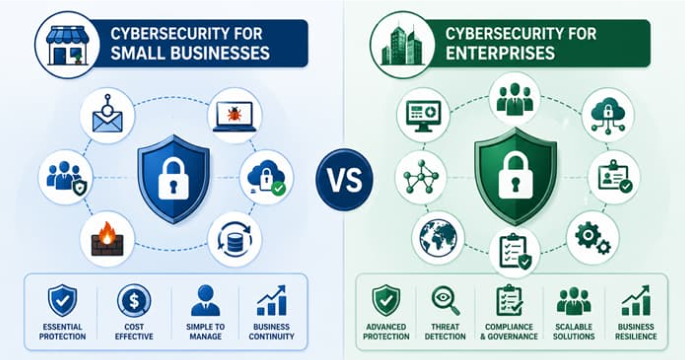
Small businesses
Small businesses are often targeted because they usually have fewer security controls and limited internal expertise.
Common needs include:
- phishing and email protection
- endpoint security
- backup and recovery readiness
- vulnerability scanning
- access control
- employee security training
Mid-sized companies
Mid-sized organizations often outgrow their early security setup. As they scale, they gain more users, endpoints, tools, and data, but their security controls may not evolve at the same pace.
Common needs include:
- continuous threat monitoring
- endpoint and network protection
- cloud security reviews
- vulnerability management
- compliance support
- incident response planning
Enterprises
Large organizations operate in more complex environments with broader attack surfaces, stricter compliance requirements, and greater financial and reputational risk.
Common needs include:
- advanced threat detection and response
- managed security operations
- cloud and hybrid security
- governance, risk, and compliance support
- identity and access management
- third-party risk management
- enterprise-wide incident response
Industry-specific businesses
Some sectors have greater security demands because of the data they handle and the regulations they must meet. These include:
- healthcare
- finance
- legal
- retail and eCommerce
- SaaS and technology
- manufacturing
Key takeaway
Whether a business is small, growing, or enterprise-level, the right cybersecurity strategy depends on real operational needs, risk exposure, and the value of the systems and data being protected.
Main Types of Cybersecurity Services

Cybersecurity is not a single service. Businesses need different forms of protection depending on their infrastructure, risk profile, and compliance needs. Most organizations rely on a mix of services to create a layered defense.
Managed cybersecurity services
Managed cybersecurity services provide ongoing monitoring, alert management, and security support through an external provider.
Typically include:
- 24/7 monitoring
- threat detection
- alert triage
- reporting
- security recommendations
Network security services
These services protect business networks from unauthorized access and malicious traffic.
Typically include:
- firewall management
- intrusion detection and prevention
- secure network design
- VPN protection
- segmentation
- traffic monitoring
Endpoint security services
These services protect laptops, desktops, mobile devices, and servers from compromise.
Typically include:
- malware protection
- ransomware defense
- device monitoring
- endpoint detection and response
- policy enforcement
Cloud security services
These services help protect cloud-based systems, data, workloads, and configurations.
Typically include:
- cloud assessments
- configuration reviews
- cloud access controls
- workload protection
- cloud monitoring
Threat detection and response
These services help businesses detect suspicious activity, investigate alerts, and contain threats before they escalate.
Typically include:
- real-time monitoring
- incident detection
- alert investigation
- containment support
- remediation guidance
Vulnerability assessments
These help identify security weaknesses before attackers exploit them.
Typically include:
- vulnerability scanning
- severity analysis
- remediation recommendations
- periodic reassessment
Penetration testing
These services simulate real-world attacks to test defenses and reveal exploitable weaknesses.
Can cover:
- web applications
- networks
- APIs
- cloud systems
- access controls
Security audits and compliance support
Security audits and compliance support help businesses evaluate their security posture against standards, regulations, or internal requirements.
Typically include:
- gap analysis
- policy review
- audit readiness
- documentation review
- control improvement guidance
Identity and access management
These services control who can access systems, data, and applications.
Typically include:
- MFA
- role-based access control
- least privilege enforcement
- privileged account management
- access reviews
Email and phishing protection
These services protect businesses against phishing, malicious attachments, impersonation, and email fraud.
Data protection and backup security
These services help secure sensitive data and maintain recovery readiness.
Incident response and recovery
These services help businesses contain, recover from, and learn from security incidents.
Security awareness training
These services help employees recognize threats and reduce human-driven risk.
How Cybersecurity Services Work
Professional cybersecurity services usually follow a structured delivery model rather than a one-time setup. The goal is to build protection, maintain visibility, and improve security over time.
1. Security assessment
The provider reviews the business environment to identify:
- important systems and assets
- vulnerabilities and gaps
- likely risks and threat exposure
- current controls and weaknesses
2. Strategy and planning
Based on the assessment, the provider builds a roadmap to prioritize the most important improvements.
This may include:
- endpoint protection improvements
- stronger access controls
- cloud security enhancements
- vulnerability management
- incident response planning
- compliance-related controls
3. Implementation
The provider then puts technical controls, tools, and policies into place.
This may include:
- endpoint deployment
- firewall setup
- MFA enablement
- cloud security adjustments
- monitoring setup
- backup protection
- access control improvements
4. Monitoring and management
Security is then monitored continuously so threats can be detected and handled early.
This stage may include:
- alert investigation
- suspicious activity monitoring
- incident escalation
- regular reporting
- policy and control management
5. Continuous improvement
As threats evolve and business environments change, cybersecurity must also improve. This includes:
- regular reviews
- control updates
- lessons learned from incidents
- policy adjustments
- expansion of protections as the business grows
Key takeaway
Cybersecurity works best as an ongoing process:
- assess
- plan
- implement
- monitor
- improve
That cycle is what makes professional cyber protection services more effective than one-time fixes.
Key Benefits of Cybersecurity Services
The value of cybersecurity services goes beyond threat prevention. These services help businesses operate more safely, confidently, and consistently.
Core benefits include:
- reduced risk of cyber attacks
- improved business continuity
- stronger compliance readiness
- better visibility into threats
- access to security expertise without building a full internal SOC
- faster incident response
- improved customer and stakeholder trust
- scalable protection as the business grows
Why these benefits matter
Together, these advantages help businesses reduce disruption, improve resilience, and create a stronger foundation for digital growth.
Cybersecurity Services vs In-House Security Team
One common question businesses ask is whether they should build an internal security team or work with external cybersecurity services. The right approach depends on budget, expertise, coverage needs, and operational complexity.
In-house security team strengths
- deeper familiarity with internal systems
- closer alignment with company operations
- stronger internal ownership
In-house security team challenges
- higher hiring and training costs
- limited specialist coverage
- difficulty maintaining 24/7 monitoring
- slower scaling
External cybersecurity service strengths
- broader expertise
- faster deployment
- access to mature tools and workflows
- more flexible service models
- stronger monitoring coverage
External service challenges
- less day-to-day internal presence
- dependence on provider communication and responsiveness
Why many businesses choose a hybrid model
Many mid-sized and enterprise businesses use a hybrid approach where internal IT or security teams handle business-specific operations, while external providers support monitoring, advanced detection, incident response, or specialized assessments.
How to Choose the Right Cybersecurity Service Provider
Choosing a provider is not just a technical decision. It is a business decision that affects risk, continuity, compliance, and trust.
Businesses should evaluate:
- business fit and risk alignment
- cybersecurity expertise
- industry experience
- 24/7 monitoring capability
- compliance support
- reporting and transparency
- response times and SLA commitments
- customization options
- scalability
- customer support quality
Important questions to ask
Before choosing a provider, businesses should ask:
- Do you offer 24/7 monitoring?
- Do you support incident response?
- What services do you specialize in?
- Do you support compliance needs?
- Can services be customized for our business?
- How do you report threats and incidents?
- How quickly are critical alerts handled?
- Can your services scale with our growth?
What Businesses Should Look for in Managed Cybersecurity
When evaluating managed cybersecurity, businesses should look for more than basic monitoring. A strong provider should deliver continuous visibility, faster response, and practical security guidance.
Key things to look for
- managed detection and response
- continuous monitoring
- threat intelligence
- endpoint management
- clear reporting dashboards
- defined incident escalation
- proactive security recommendations
Why this matters
The best managed cybersecurity providers do not only watch alerts. They help businesses detect threats faster, reduce noise, improve visibility, and strengthen security posture over time.
Enterprise Cybersecurity Needs and Challenges
Enterprise cybersecurity requires a different level of maturity because larger organizations face more complexity, more users, more systems, and greater exposure.
Common enterprise challenges include:
- large-scale environments
- multi-location infrastructure
- complex access controls
- compliance burden
- third-party risk
- cloud and hybrid environments
- advanced persistent threats
- the need for centralized monitoring and governance
Why enterprises need a different approach
Large organizations often need:
- stronger identity and access governance
- broader monitoring
- scalable security operations
- cloud and hybrid security controls
- third-party risk management
- advanced threat detection and response
- centralized oversight across teams and systems
Final Thoughts
Cybersecurity is no longer a secondary business concern. It is a core part of resilience, continuity, and operational trust. Whether a business is small, growing, or enterprise-level, the right cybersecurity services help reduce risk, improve visibility, and strengthen long-term protection.
The most effective approach is not to rely on one tool or one isolated service. It is to build a layered, proactive security strategy that matches the business’s size, industry, risk exposure, and growth plans.