In today’s digital environment, businesses rely on technology to manage operations, store data, and communicate with customers. While this improves efficiency, it also increases exposure to cyber threats such as ransomware, phishing, and data breaches. As organizations adopt cloud platforms, remote work tools, and connected services, the risk of cyber incidents continues to grow.
A cybersecurity risk assessment helps organizations identify threats, vulnerabilities, and weaknesses before attackers exploit them. By conducting a structured cyber risk analysis, businesses can understand their risk exposure, prioritize improvements, and strengthen protection around critical assets.
What Is a Cybersecurity Risk Assessment?

A cybersecurity risk assessment is a structured process used to identify, analyze, and evaluate security risks that could affect an organization’s systems, data, networks, and operations. Its purpose is to determine where weaknesses exist, what threats could exploit them, and how serious the impact could be.
Instead of reacting after an incident occurs, a risk assessment helps organizations take a proactive approach to security.
A cybersecurity risk assessment helps answer:
- What assets and systems need protection?
- What threats could target them?
- How severe would the impact be?
Key components of a cyber risk assessment
- Assets
Systems, data, applications, devices, and infrastructure that require protection. - Threats
Possible sources of harm such as ransomware, phishing, insider threats, malware, and credential theft. - Vulnerabilities
Weaknesses attackers could exploit, including outdated software, weak passwords, misconfigurations, and unpatched systems. - Likelihood
The probability of a threat successfully exploiting a vulnerability. - Impact
The potential damage to operations, finances, compliance, or reputation.
Cyber risk assessment vs security audit
A risk assessment identifies threats, vulnerabilities, and business impact.
A security audit checks whether current controls and policies meet required standards.
Both are important, but they serve different purposes.
Why organizations perform risk assessments
Businesses conduct cybersecurity risk assessments to:
- reduce exposure to cyber threats
- improve overall security posture
- support compliance requirements
- prioritize security investments
Why Cybersecurity Risk Assessments Are Important
Cyber threats continue to grow in frequency and complexity. A cybersecurity risk assessment helps organizations understand where security gaps exist and how those weaknesses could be exploited.
Main reasons they matter
- uncover hidden vulnerabilities
- help reduce the likelihood and impact of data breaches and attacks
- support compliance and audits
- improve business continuity
- prioritize security spending
Common security gaps discovered during assessments
- outdated software or missing patches
- weak authentication controls
- misconfigured cloud services
- exposed network services
- excessive user permissions
By identifying these issues early, businesses can reduce risk before incidents occur.
Types of Cybersecurity Risk Assessments

Organizations often perform different types of assessments depending on their environment and risk exposure.
Network Risk Assessment
Evaluates firewalls, open ports, segmentation, remote access, and monitoring to identify weaknesses in network infrastructure.
Application Security Assessment
Focuses on web apps, mobile apps, internal software, and APIs to identify issues such as insecure authentication, poor access control, and insecure integrations.
Cloud Security Risk Assessment
Reviews cloud configurations, access permissions, storage exposure, workload security, and monitoring to ensure cloud environments are secure.
Third-Party Risk Assessment
Evaluates vendors, suppliers, partners, and service providers that have access to systems or data.
Enterprise Security Risk Assessment
A broader assessment of cybersecurity risks across the organization, including governance, policies, infrastructure, applications, endpoints, and response readiness.
Cybersecurity Risk Assessment Frameworks
Using a structured framework makes cyber risk analysis more consistent and reliable.
Common frameworks include:
- NIST Risk Management Framework (RMF)
A broader risk management framework that includes categorization, control selection, implementation, assessment, authorization, and continuous monitoring. - ISO 27005
A risk management standard that supports information security governance and aligns with ISO 27001. - CIS Risk Assessment Approach
A practical method focused on identifying critical assets, evaluating risks, and aligning security controls. - OCTAVE
A framework that evaluates cybersecurity risks based on business and operational impact.
Why frameworks matter
They help organizations:
- conduct consistent assessments
- prioritize risks based on impact
- improve documentation
- align with recognized standards
- strengthen security decision-making
The Cybersecurity Risk Assessment Process

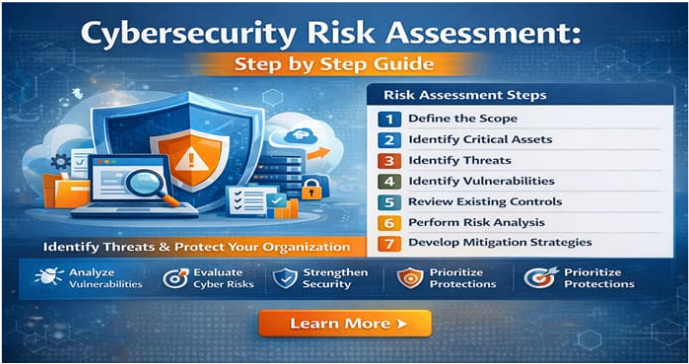
A cybersecurity risk assessment typically follows a step-by-step process.
Step 1: Define the Scope
Determine which systems, assets, departments, and data types will be included.
Step 2: Identify Critical Assets
List the systems, data, infrastructure, and applications that are most important to the organization.
Step 3: Identify Threats
Identify likely threats such as ransomware, phishing, insider threats, credential theft, and supply chain attacks.
Step 4: Identify Vulnerabilities
Look for weaknesses such as outdated software, weak passwords, poor configurations, and unpatched systems.
Step 5: Review Existing Controls
Evaluate which safeguards are already in place and whether they reduce the likelihood or impact of identified risks.
Step 6: Perform Cyber Risk Analysis
Evaluate each risk based on:
- Likelihood
- Impact
- effectiveness of existing controls.
Step 7: Prioritize Risks
Classify risks as high, medium, or low so teams can focus on the most serious issues first.
Step 8: Develop Mitigation Strategies
Decide how risks will be reduced through controls, policy changes, monitoring, or remediation.
Step 9: Implement Security Controls
Apply the required fixes and controls, such as patching, MFA, firewall improvements, and monitoring tools.
Step 10: Document Findings
Record vulnerabilities, risk ratings, mitigation plans, and implementation progress.
Step 11: Monitor and Review
Repeat the assessment regularly as systems and threats evolve.
Cybersecurity Risk Assessment Tools
Security tools support the assessment process by helping teams discover vulnerabilities, track assets, and monitor activity.
Common tool categories
- Vulnerability scanners
Detect missing patches, outdated software, insecure configurations, and exposed services. - Risk assessment platforms
Help track assets, document vulnerabilities, score risks, and manage workflows. - Threat intelligence tools
Provide visibility into current attack techniques, malicious indicators, and emerging threats. - Security monitoring tools
Monitor system, network, and user activity to detect suspicious behavior.
Important note
Tools are useful, but they do not replace the assessment process. Human analysis is still needed to evaluate business impact, prioritize risks, and decide on mitigation strategies.
Common Cyber Risks Identified During Assessments
A cybersecurity risk assessment often reveals recurring weaknesses across systems and environments.
Common risks include:
- phishing vulnerabilities
- weak authentication controls
- cloud misconfigurations
- exposed services
- unpatched systems
- insider threats
- insecure APIs
These risks often arise from poor configurations, outdated systems, weak policies, or human error.
Challenges in Conducting Cyber Risk Assessments
Although risk assessments are important, organizations often face challenges when conducting them effectively.
Common challenges include:
- limited visibility across systems
- lack of internal security expertise
- rapidly changing threat landscape
- complex IT environments
- resource and budget constraints
Understanding these challenges helps businesses plan more realistic and effective assessments.
Best Practices for Effective Cybersecurity Risk Assessments
To get real value from a cybersecurity risk assessment, organizations should follow clear best practices.
Best practices include:
- perform assessments regularly
- use structured frameworks
- involve cross-department stakeholders
- prioritize high-impact risks
- document findings clearly
- combine technical and business perspectives
These practices help ensure the assessment produces useful, actionable insights.
How Often Should Organizations Conduct Risk Assessments?
A cybersecurity risk assessment should be performed regularly and whenever significant change occurs.
Common times to conduct one
- annually
- after major infrastructure changes
- after security incidents
- before compliance audits
- when adopting new technologies
This helps organizations keep pace with evolving threats and system changes.
Cybersecurity Risk Assessment vs Vulnerability Assessment
A vulnerability assessment identifies technical weaknesses in systems and software.
A cybersecurity risk assessment evaluates how those weaknesses affect the organization and what level of business risk they create.
Main difference
| Aspect | Risk Assessment | Vulnerability Assessment |
| Focus | Overall risk exposure and business impact | Technical weaknesses |
| Scope | Strategic and technical | Technical only |
| Output | Prioritized risks and mitigation strategies | List of vulnerabilities |
A vulnerability assessment supports a risk assessment, but it does not replace it.
Who Should Perform a Cybersecurity Risk Assessment?
A cybersecurity risk assessment can be performed by different types of teams depending on the organization’s size and maturity.
Internal security teams
Best for organizations with experienced in-house professionals who understand internal systems and operations.
Third-party consultants
Useful when a business needs independent, specialized, and unbiased evaluation.
Managed security providers
A strong option for organizations that need ongoing monitoring, regular analysis, and external expertise.
In many cases, a hybrid approach works best.
Industries That Benefit Most from Cyber Risk Assessments
While every business can benefit, some industries face higher cyber risk because of the data they handle or the systems they rely on.
High-risk industries include:
- healthcare
- finance
- SaaS and technology
- government and public sector
- retail and eCommerce
- manufacturing
These sectors often manage sensitive information, critical services, or high-value digital systems.
Benefits of Conducting Regular Cybersecurity Risk Assessments
Regular assessments help organizations stay ahead of threats and continuously improve their defenses.
Key benefits include:
- improved security posture
- better decision-making
- stronger compliance readiness
- reduced likelihood of breaches
- improved incident response planning
Together, these benefits support stronger cybersecurity resilience and business continuity.
Cybersecurity Risk Assessment Checklist
A simple checklist helps keep the assessment process organized and consistent.
Basic checklist
- define the scope
- identify critical assets
- identify threats
- identify vulnerabilities
- analyze risk
- prioritize risks
- implement mitigation
- document results
- review regularly
When Businesses Should Conduct a Risk Assessment
Businesses should not rely only on fixed schedules. Risk assessments should also be performed when major changes occur.
Common trigger points
- before digital transformation
- after major infrastructure changes
- after a security incident
- before compliance certification
- when expanding cloud usage
These situations often introduce new vulnerabilities and require updated security evaluation.
Future of Cyber Risk Assessments
Cybersecurity risk assessments are becoming more dynamic as technology and threats evolve.
Key trends include:
- AI-driven risk analysis
- automated security evaluation
- continuous risk monitoring
- integration with Security Operations Centers (SOC)
- risk-based cybersecurity strategies
These changes are helping organizations move from periodic assessments to more continuous and intelligent risk management.
Conclusion
A cybersecurity risk assessment is a core part of modern cybersecurity strategy. It helps organizations identify vulnerabilities, understand threats, and prioritize the actions that matter most.
Rather than waiting for incidents to happen, businesses can use risk assessments to take a proactive approach, improve security posture, support compliance, and strengthen resilience over time.
Regular assessments, combined with the right frameworks, tools, and mitigation strategies, help organizations protect critical assets and make better security decisions in an increasingly complex threat landscape.